Experience Bangkok: Unveiling the Vibrant Heart of Thailand
Experience Bangkok: Unveiling the Vibrant Heart of Thailand
Bangkok, the bustling capital of Thailand, is a city that often gets overlooked by travelers eager to hit the country’s famous beaches and islands. While destinations like Phuket and Pattaya draw in beach lovers, and the ancient kingdom of Lanna attracts culture enthusiasts, Bangkok stands as a hidden gem waiting to be discovered. This vibrant city offers a rich tapestry of attractions, entertainment, cuisine, and shopping. For five consecutive years, it has topped global rankings in tourist popularity, even surpassing London and Paris. Although current global circumstances might limit our ability to explore Bangkok in person, we can still embark on a virtual journey and plan for future adventures.
Why Visit Bangkok?
The benefits of traveling to Bangkok are numerous and reflect the advantages of visiting Thailand as a whole. Here are some key points:
- Affordable airfare and manageable flight durations
- A wide range of suitable layovers and reputable airlines
- A well-developed tourism industry with diverse hotels, restaurants, and tour firms catering to various tastes and budgets, including Russian-speaking guides
- Safety, low violent crime rates against tourists, and a friendly local population
- A warm climate and low internal prices
Getting Around Bangkok
Bangkok is a sprawling metropolis covering over 1,500 square kilometers. Consequently, its public transportation system is highly developed and varied. The city boasts multiple metro lines, buses, songthaews (shared taxis), and boats and ferries that are particularly useful in the central areas. Additionally, Bangkok offers some of the world’s most affordable taxi services, including cars, motorcycles, and tuk-tuks, which can be hailed via the Grab app, a successor to Uber.
Choosing Your Accommodation
Your choice of accommodation will significantly influence your experience of Bangkok. The city’s diverse districts offer vastly different atmospheres, from business centers to historic areas and residential neighborhoods. Tourists can find attractions, museums, entertainment, and shopping to suit their preferences and budgets, provided they choose the right location and plan their itinerary wisely. Given the city’s size and the scale of its attractions, it’s essential to account for travel time and the scope of the sites you wish to visit. Bangkok is not like European cities; its palaces and temples can take more than a couple of hours to explore thoroughly.
Recommended Areas for First-Time Visitors
Pratum District
Within walking distance, you’ll find the Baiyoke Sky Hotel with its famous observation deck, a night market, the airport metro, Victory Monument (a hub for public transportation, including buses to various cities), and several other attractions.
Chinatown
Located near the railway station, Chinatown offers easy access to the Grand Palace and major museums. It’s also close to the boats that traverse the central ring, similar to Moscow’s Garden Ring.
Khao San Road
This bustling street is the heart of Bangkok’s nightlife, with activities continuing until the early hours. Many attractions are within walking distance. Despite its modest length of 400 meters, Khao San Road is packed with experiences. You can sample fried scorpions and snake blood, enjoy street musicians, dance, book tickets to any destination in the country, find various excursions, get colorful braids, indulge in Thai massages, explore beauty salons, rent motorcycles, visit tattoo and piercing parlors, browse music and book stores, stay in luxury hotels or budget hostels, and dine at cafes offering cuisines from around the world.
Must-See Attractions in Bangkok
Bangkok’s top attractions include the Grand Palace with Wat Phra Kaew (home to the Emerald Buddha), Wat Pho (the Temple of the Reclining Buddha), and Wat Arun (the Temple of Dawn).
The Grand Palace
Constructed in a record three years, the Grand Palace covers an impressive 218,000 square meters. The surrounding wall alone stretches nearly two kilometers. The palace complex houses numerous beautiful structures, including 12 small open pavilions built by King Rama I, stupas commemorating the king’s parents, a model of Angkor Wat symbolizing Cambodia’s historical subordination to Thailand, a bell tower, a library, a reserve library guarded by demons and adorned with pearl-inlaid doors, separate temples housing sacred images and statues, towers dedicated to significant Buddhist elements and figures, and various galleries, including a stunning long gallery depicting scenes from the Ramayana.
If you visit the palace without a guide, consider renting an audio guide available in Russian. It’s an affordable and high-quality way to learn about the palace’s history and significance.
Wat Phra Kaew
Located within the Grand Palace, Wat Phra Kaew houses the Emerald Buddha, one of Thailand’s most revered relics. According to legend, the statue was discovered after a lightning strike revealed an ancient stupa in northern Thailand. For nearly three centuries, the Emerald Buddha traveled across the country and was even taken to Laos and Burma. However, in the 18th century, it found its permanent home in the capital. The king personally changes the statue’s attire three times a year.
The Emerald Buddha, though small (approximately 50 cm wide and 60 cm tall, including its base), is enshrined in a lavish temple. The Buddha sits on a throne that is itself a work of art, surrounded by walls adorned with exquisite paintings depicting scenes from the Buddha’s life. Photography is prohibited inside the temple.
Wat Pho
Wat Pho is Bangkok’s most notable monastery, renowned for being the oldest (even older than the city itself), the largest, and the first to become an educational institution. It is also home to the largest statue of the Reclining Buddha, measuring 46 meters in length and 15 meters in height, covered in gold and inlaid with mother-of-pearl. Photographing the entire statue is challenging due to its size; visitors can only capture parts of it.
The monastery also features a popular tourist activity: tossing coins into 108 bowls to improve one’s karma.
Wat Arun
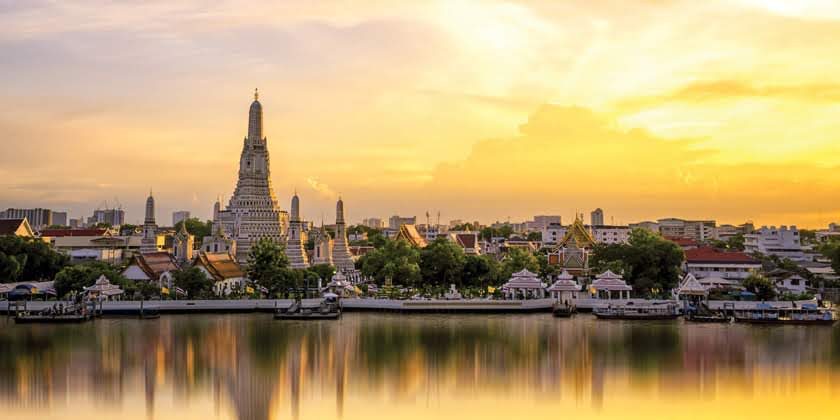
Wat Arun, also known as the Temple of Dawn and the Temple of the Sunrise, is a relatively new temple dating back to the mid-19th century. It is famous for its observation deck and striking decor, with an almost 80-meter-high pagoda adorned with colorful porcelain and ceramic tiles. The best views of Wat Arun can be enjoyed from the river. Consider taking one of the traditional evening cruises featuring music, dinner, and the opportunity to admire the illuminated attractions of the city center.
Siam Niramit Show
The breathtaking Siam Niramit show, renowned for its beauty and complexity, is a must-see in Bangkok (the Phuket version is a simplified adaptation). The show features impressive special effects, vibrant costumes, a captivating storyline, music, dance, animals, and acrobatics.
Before the performance, visit the idyllic folk village. This village showcases various structures, including houses.