Love is Power: An Interview with Artist and Writer Lena Zinski
Love is Power: An Interview with Artist and Writer Lena Zinski
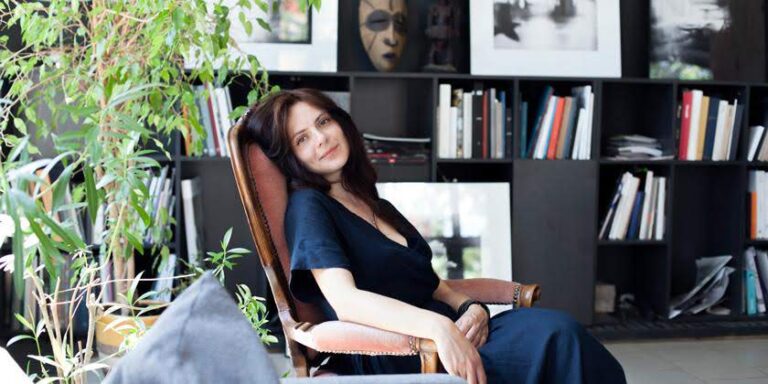
If humans could fly, our world would have entirely different contours—a notion we can only fantasize about. Yet, among us, there are those who seem to soar, brimming with creative and constructive energy. Today, we introduce such an individual in our “Persona” section—Lena Zinski, a “bird,” poet, artist, and so much more.
Lena, could you please complete the sentence “I am Lena Zinski”?
“Well, that’s a direct question,” she laughs. “Alright, I am a poet, an artist, an initiator, and creator of various projects—ranging from a book club that advocates for professional and personal development to a creative studio within my own business. These are the diverse roles that make up who I am.”
There’s a quote from Jhumpa Lahiri, an American writer I admire, from her non-fiction work “In Other Words,” which I’ll paraphrase: “All my life, I wanted to see an accurate image within the framework of my own self. A whole person, not a fragmented one. But it wasn’t there… Then I realized that I am made of this uncertainty. It is my source, my destiny. From this void, from all this uncertainty, comes the creative impulse. The impulse to fill the frame.” The same goes for me. Different images feed off each other, complementing one another. There’s no precision, but there’s a tremendous desire to fill the void and unwavering efforts to do so.
One of your personal and professional roles is that of a poet. Could you tell us about your collections? Who and what are they about?
To date, I have published four books: two poetry collections, a children’s alphabet book, and an anthology in which I am a co-author. Additionally, four children’s books are ready but not yet published, and another poetry collection is complete, quietly waiting its turn. While in the West, I have shifted my focus to immersing myself in the local creative realities.
Poetry is about capturing emotions and preserving them with words. The author’s task is to do this consciously and meaningfully.
My first collection was written in the wake of my youth, reflecting my time in London where I lived for nearly nine years. It includes many poems from my travels, about encountering the world, and about love. I finished “Poles” in Greece, where we had a significant project that kept us there for extended periods. The next, yet unpublished third collection will be titled “Mother-and-Stepmother.” I am still contemplating the title for my first entirely English-language collection.
What are your paintings about, and what techniques do you use to create them?
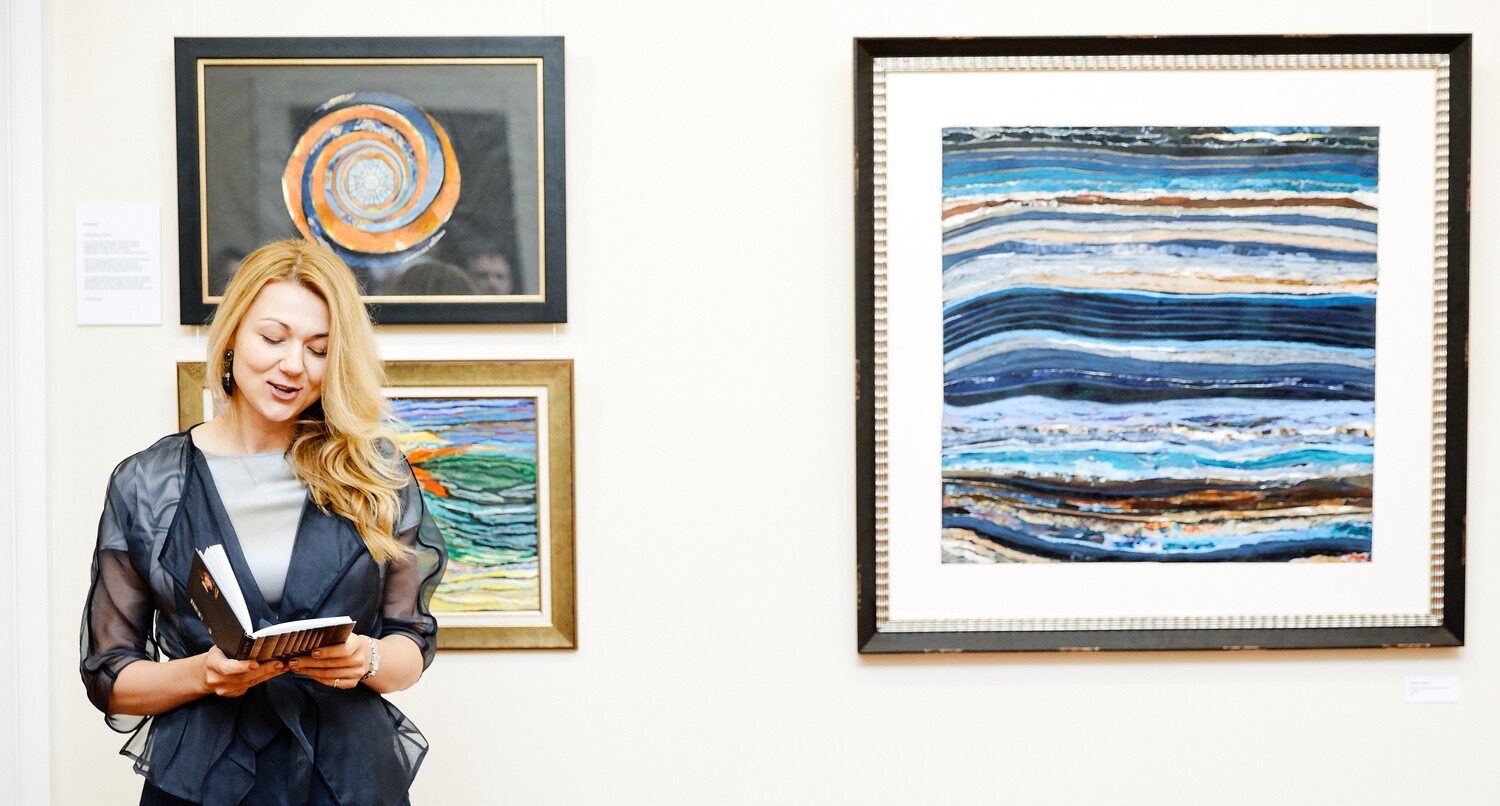
I enjoy the collage technique. Most often, I paint realistic images with acrylics because, unlike oils, acrylics are compatible with paper. Then, I add collage patterns. Currently, I am working on a series called “Dreams.” These will be quite large, abstract works filled with micro-meanings through inserts of smaller fragments—patterns, curtains, prisms of creation.
Have you ever emulated anyone in your creative style? Who inspires you?
Emulating is boring, so no. However, I constantly draw ideas from others. A favorite poem, painting, word, exhibition, product—anything that catches my attention in terms of meaning or aesthetics. I create clippings and mood boards. Inspiration comes when there is a stimulant. The works of others greatly help in activating my own subconscious.
In your view, should an artist, poet, or writer reflect reality? Should they respond to events and not remain indifferent to current issues, or is it a different world?
Art cannot remain indifferent to what is happening in society precisely because it grows from the emotions that society experiences. Happiness needs to be noticed, while pain and injustice are always visible—they pour out into words and paintings.
From your books to creating a book club. Tell us about the club: why did you create it, and for whom?
The idea of a club for people who read, write, and create has been with me for a long time, dating back to my London days. I wanted to create a community and hold meetings. But back then, I was looking for a place-based connection, which was the complexity and the mistake. When the pandemic started, I attended Zoom events with outstanding thinkers from around the world—some in California, others in Berlin, and so on. That’s when I decided to turn my corporate book club into a social project, far beyond the organization’s framework, while preserving its inner value and my life motto: “Tomorrow I will be better than yesterday.” Thus, Always Be Better was born, and that’s why it’s named as such.
One of the unique features of your club is the live meetings with authors that you hold once a month. Who are the guests at your meetings?
People who interest me. Readers who share our values—constantly striving to be better, regardless of what they have already achieved. These are authors, artists, opinion leaders. Recently, our guest was Belarusian writer Tatiana Zamirovskaya, author of the acclaimed novel “Death.net.” We discussed her book of stories “Land of Random Numbers.” In November, for example, our guests will be teen writers Evgenia Pasternak and Andrei Zhvaleuski—we will talk about literature for teenagers, come join us! A little earlier, we had Zhenya Chernyavskaya with Tel Aviv realities and Maria Gvardeytseva, with whom we discussed contemporary art and books dedicated to this topic. In December, we plan a virtual New Year’s gathering with poets. There are so many ideas!
Successful projects always inspire. What about failures? Can you tell us about something you really wanted in life but never managed to achieve?
I try to look at failures as an opportunity to reconsider where we still fall short, to learn a lesson, so I consider them a stop on the way to the goal. There is still much unrealized, both in work and in creativity. I am convinced that every experience is given to us for a reason—our task is to assimilate, digest, and derive meaning from it.
In your opinion, which public woman today is the “voice of the world”?
There are several women I truly admire. One of them is a designer who, together with her builder husband, started a studio to renovate old houses. This studio then grew into a TV project, then a magazine, then books, then a microtown within a city in Texas, restaurants, shops—a huge community celebrating their small town in Texas. You might have expected a different example from me. But I admire her ability to realize her own dreams, thereby transforming the society around her. Her name is Joanna Gaines. By the way, she will soon release a new book about all her adventures.
Favorite Books
From professional literature: “Conscious Business” by Fred Kofman. From personal development books: “The Choice” by Eger, which we discussed at the very first meeting of the Always Be Better club. In poetry, I really love contemporary American poets—and there are many favorites: Jane Hirshfield, Ilya Kaminsky, Maggie Smith. From recently read non-fiction: “Seven Good Years” by Etgar Keret. From fiction, I would highlight the historical novel “Red Cross” by our Belarusian writer Sasha Filipenko and “It Seems Esther” by Katya Petrovskaya, a German writer born in Kiev.
Finally, let’s fantasize: you are flying to Mars—what would you take with you?
Once, before pregnancy, my husband and I were preparing for a long hiking trip. He tried to prepare me for the fact that we would have to live without any jars or creams, but most importantly, no books, except maybe a Kindle. Paints were also not an option because we had to carry everything ourselves. A pencil and a notebook—that’s all. I was so excited about the upcoming trip that I even got pregnant, she laughs. I wouldn’t rush to go to Mars either, unless…