Sergey Milyukhin: My African Journey to Understanding Love
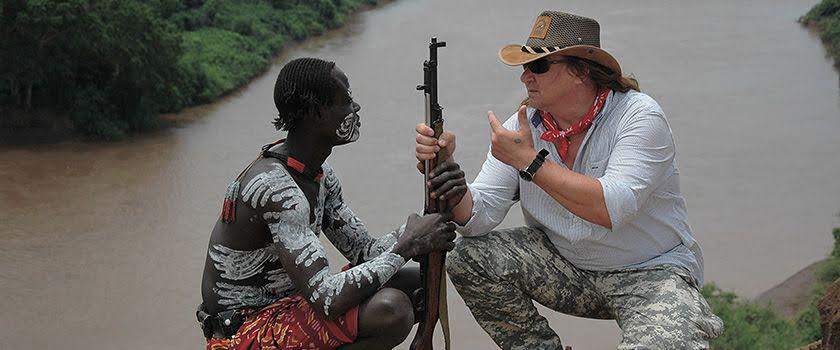
Sergey Milyukhin’s Grand African Adventure
Sergey Milyukhin’s grand African adventure began nearly a decade ago, surprisingly, in Brazil… and it hasn’t ended yet. Even the experiences he’s had so far would be enough for many to fill two and a half lifetimes.
Why Africa is Like the Cosmos
Sergey, I know you’ve traveled half the world: you’ve been to Australia, Europe, Brazil, the USA, Asia, but your true passion is Africa. Why?
Let’s start from childhood. I grew up in a military town called Mirny, near the Plesetsk Cosmodrome. Life there is the shortest path to the cosmos because that’s where satellites were launched. If at night there was a roar and it became as bright as day, we knew that another space satellite had been sent into Earth’s orbit. The topic of space always fascinated me, and I saw cosmonauts as celestial beings. By a twist of fate, I met a man who himself is like the cosmos. And I met him completely by chance in Brazil. His name is Georgy Mikhailovich Grechko, our famous cosmonaut. We spent long hours in pleasant conversations, and once he asked, “Sergey, have you ever been to Africa?” I replied that, of course, I had, thinking of trips to Egypt with children. And he said, “That’s not Africa. Africa is the central, southern, and eastern parts of the continent. Africa is like the cosmos.” I was skeptical about this statement then, but my trust in Georgy Mikhailovich was so great that the next time I decided to go to the real Africa, according to him. And the first time I flew to South Africa. I went to the Cape of Good Hope, where probably every boy who held a globe in his hands dreamed of being. Then I was in Cape Town, Johannesburg, Durban, Hermanus – a bay where the largest mammals on the planet, blue whales, come to raise their calves… And in total, since then, I have been to Africa 36 times and visited 16 countries on the continent.
Zambia: Victoria Falls
You know, Africa is always like this… when you stand on the plain, it seems like you’re on top of a mountain. Because the horizons there are expanded, vast, endless, like the cosmos. Perhaps due to the abundance of mountains or the very high sky, or the two oceans that wash the shores of this continent, an incredible feeling arises.
In Durban, I met another “cosmic man” – Nikolai Nikolayevich Drozdov. It was he who, after listening to me tell tourists about Africa, advised me to write down my stories. That’s how my African notes for the media were born.
Gorillas and the Eyes That Speak
And in them, I read about how you went to meet gorillas, and they let you very close. But what did you see in the eyes of a gorilla?
In the eyes of these animals, I saw more than I sometimes see in the eyes of some people. It was truly a unique encounter. There are only about 300 mountain gorillas left on Earth. And they survived thanks to one person – Dian Fossey, an ethologist, an American scientist who wrote the book “Gorillas in the Mist” and who protected them from poachers, lived with them in a hut, befriended them, loved them. She understood that man is not sent to this earth to destroy it, but to preserve it. After all, any wild animal is stronger than man, but it is defenseless against man because progress and weapons are on the side of man, and wild animals only have fangs and claws.
Before meeting the gorillas, I was a bit scared to go to the Virunga mountains. After all, the stereotype that this is a very large and formidable ape is strong within us, and the image of King Kong, who destroys buildings and tears people apart, is alive… But when I saw the first gorilla, who was sitting in her nest and holding a baby in her arms, that fear disappeared somewhere. Gorillas make their nests on the ground. Like humans, they are lazy, they don’t like to clean up after themselves, so every night they have a new home. In a family, there are 5-6 females and each has 1-2 cubs. A maximum of three. I was lucky enough to meet a dominant male who was sitting, sprawled out under a tree, chewing on some grass, and looking straight at me. Nothing more. He just looked and chewed his grass. And then I realized that I would never be able to call them animals again. I won’t call them people yet, but the facial expressions I saw, the facial features, not muzzles, the thoughts in their eyes… I am absolutely sure that I was silently communicating with a smart creature! According to the rules, you could only spend one hour with the gorillas, but we stayed there for two. And I can definitely say: they are like us, only better.
Where Noah Brought His Ark
You were in Tanzania, and there is a completely amazing place there, from where, according to one of the theories, life on Earth originated. Tell us about it.
The Olduvai Gorge. It is there, according to scientists, that the first ape-like human appeared, and the remains of the very first human were found there. This place is unique because it is located in the area of the Great African Rift and a chain of fiery volcanoes. There are a total of 115 active volcanoes in this small area. And the 116th, although inactive, is the Ngorongoro volcano. At an altitude of 2280 meters, where in ordinary mountains mosses, lichens, and in some places glaciers begin, on Ngorongoro there is an alpine meadow. A huge caldera of an extinct volcano with a diameter of 21 kilometers and a height of 600 meters, closed on all sides. Animals cannot leave there and cannot enter. Except for birds. This is a micro-world. When you drive there in the morning and see a bird carrying some kind of snake, then see a buffalo grazing peacefully, then a lion lying under a tree… that’s it, you stop understanding anything at all. As if you are in a branch of paradise.
In this place, I remembered one of my favorite biblical pages – the great flood. When the Creator was angry with people, he sent a great water to the earth, but he informed the righteous Noah about it, who built an ark and put a pair of every creature on it. Everyone knows this story. And Noah landed his ark on Mount Ararat, according to the Armenians. But if he landed them on Ararat, where did they all go? Why didn’t the animals stay in the Caucasus? Did they walk to Africa? (Laughs.) Actually, I think that all of them were landed in the Ngorongoro crater. Later, when I began to study the tales and legends of African peoples, I came across a legend according to which the gods sent a great water to the earth and warned the righteous Tumbainot about it, who collected animals of every creature in pairs, put them on a ship, and took them to the Ngorongoro crater. I am absolutely sure that life originated on the African continent.
The Great Animal Migration: Tanzania
Perhaps even in two places at once: in Africa and in Japan, because, in my opinion, the Japanese are not just another race, they are a completely different, distinct from everything that exists on Earth, species of Homo sapiens with a unique culture and philosophy. Since we’ve started talking about people, tell us about the tribes you’ve visited.
It won’t fit into one story. Mursi, Maasai, Himba, Tutsi, Pygmies, Hamar, Karo, Konso… For example, the Maasai look very warlike, but they are absolutely peace-loving people. Cattle breeders. The fact is that the Maasai have always believed that all the cattle on earth belong to them. If a young Maasai man goes to a neighboring alien tribe and steals a cow there, he will be a hero. And if he steals a cow from the Maasai, he will be executed. Because cattle is the most important wealth of the tribe. If there is cattle, there will be food, clothing, medicine. The Maasai arm themselves to protect their wealth. The most important thing for a Maasai is his livestock, second is his wife, he can have several: as many as he can afford to feed, and children are in third place, they are not counted there.
Men of the Mursi Tribe, Ethiopia
Why you shouldn’t walk alone in Africa, about the Mursi tribe and the future.
What was your most dangerous journey in Africa? When…