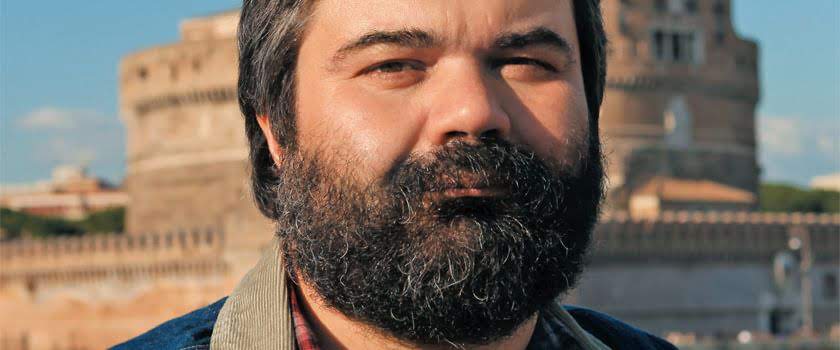
Roman Zaslonov: A World-Renowned Artist with a Pirate Beard and a Twinkle in His Eye
Roman Zaslonov: A World-Renowned Artist
Roman Zaslonov, a Belarusian artist, is globally recognized with his paintings gracing private and museum collections across nearly every continent. What captivates people more is debatable: the enchanting, festive world of his paintings or the artist himself—a remarkably positive and warm individual with a pirate beard and a mischievous twinkle in his eyes. Recently, Zaslonov’s art exhibition made its debut in Minsk, drawing significant attention.
Art and the Embodiment of Desire
In an interview, Roman Zaslonov shared his thoughts on art and the embodiment of desire:
– Roman, the opening of your exhibition in Minsk was a huge success. Did you expect such a turnout?
– I truly hoped for it. Every artist wants a large audience at their exhibition. However, I don’t think anyone anticipated the sheer number of attendees.
– I understand that your paintings for the Minsk exhibition were sent from various countries, including France and Luxembourg. How long did the preparation take?
– About a year and a half. I had always wanted an exhibition in Minsk, and at one point, Vladimir Ivanovich Prokoptsov, the director of the National Art Museum, suggested I pursue it. Gathering the paintings from collectors was challenging, as I only had four on hand. Ultimately, we assembled over 30 paintings for the exhibition. Six of my significant works arrived from America later than the others. They reached Minsk after the official opening, so we had a second, smaller opening. Given my nature, I’m surprised everything came together so well.
– Your paintings exude life and joy…
– My paintings are a physical manifestation of desire. Living in such a joyful, carefree world every day is impossible, but it’s something to aspire to.
Self-Expression and Artistic Evolution
– What is crucial in your art?
– Self-expression is probably the most important aspect. For the past century, artists have focused on self-expression. Previously, artists were part of the decor, working primarily on commission. Without commissions, artists did little. However, the traditional painting is fading. I mean the kind painted on a flat surface and hung on a wall—these are becoming rarer. In the post-Soviet space, this form is still prevalent, but globally, it has been largely replaced by other art forms like video, installations, photography, and land art. Throughout the 20th century, art critics aggressively promoted new art forms, asserting that contemporary art is superior and innovative, while oil paintings are outdated. This isn’t necessarily bad or terrible, but these forms exist parallel to my work. Perhaps I will eventually explore installations and other forms, as an artist’s development is unpredictable. Maybe there’s a stagnation in painting today, but we might only realize it a century from now.
Life Between Minsk and Paris
– You split your time between Minsk and a suburb of Paris. Having lived between two countries for nearly 20 years, how has this changed you?
– Such circumstances inevitably leave a mark, but it’s hard to say exactly how. I moved to France by chance. I was working with a gallery, and they suggested I come to live there. For an artist, having diverse means and opportunities for development is crucial.
– Where do you feel freer: there or here?
– Lately, probably here, on a metaphysical level.
About Women and Dresses
– The heroine of your paintings is a golden-haired woman. Tell us about her. Who is she?
– She is the quintessence of the image of a woman. Not consciously, where one sits and thinks about how a woman should look, her physical build, or hairstyle. It’s more about composition and plasticity. The plastic image is about lighting and action: a central figure in something bright and light against a dark background. Her further development comes during the work process.
– Still, I see a reverence for women in your works; you place her on a pedestal, elevating her above the mundane…
– Some artists tackle global issues, like violence, using shock tactics to make people think. For me, depicting horrible things is unacceptable. My inner world rebels against the ugly and terrible. What I create is what I like.
Belarusian and French Women
– Your woman ranges from 18 to 45 years old… She has broad age limits.
– This is the difference between a painting and an installation. If it were an installed photograph, we would see a young model made up to look older or vice versa. It would be a tangible, real world. Despite being a realist and my works being figurative, the painting doesn’t provide such precise representation; it retains an element of surprise.
– I can’t stop admiring your paintings in the catalog. The dresses are stunning! Have any designers offered to bring them to life?
– There was an instance. A Chinese girl bought my book, scanned it, printed my paintings on fabric in three color variants, and sewed 40-50 clothing models, from bikinis to dresses and jeans. She cut the fabric so that different paintings appeared in the center of each model. Her boutique was right next to the gallery in Paris where I exhibited. I couldn’t believe it when I saw it! In the end, I never met her because my lawyer friend intervened, scaring her so much that she closed her boutique and left.
– Belarusian and French women: what’s the difference?
– My woman is our idea of a French woman before visiting France, and I’ve preserved this in my paintings. In reality, she is a Belarusian woman, more festive, elegant, and internally richer than a French woman. I don’t quite understand the inner world of French women. They are more pragmatic and down-to-earth. I wouldn’t say our girls are dreamy and thoughtless, but it’s less poetic there.
– Really? In Belarus, we think the opposite. A French woman is light, independent, sprays herself with Chanel, and rushes to the L’Opera.
– No, there’s no opera; everything is down-to-earth. Women over 40 in France surprise me: they dress well, present themselves well, and are interesting. Young girls are very ordinary. In France, there’s a sense of friendship and equality between the sexes. It’s not customary for a man to pay for a woman in a restaurant. Even if a couple has been dating for months, they still pay separately.
About First Teachers and Globalization
– Who were your teachers?
– As a child, I drew constantly. My parents took me to a studio at the age of five, where I studied under the famous artist Sergei Petrovich Katkov. Some of my works were even exhibited in major shows.