Eliza Orzeszkowa: Five Fascinating Facts About the Renowned Belarusian Woman
Eliza Orzeszkowa: A Legendary Figure in Belarus
Eliza Orzeszkowa stands as one of the most celebrated women in Belarusian history, her contributions to the nation’s heritage are immeasurable. Notably, she was the first Belarusian to be nominated for the Nobel Prize in Literature. Delve into the intriguing aspects of her life as we present five captivating facts about this remarkable woman.
Missed the Chance to Send a ‘Voice Greeting’ to Thomas Edison
One day, a man arrived at the residence of the esteemed writer, carrying a phonograph—a device invented by Thomas Edison in 1877 for recording voices. This individual was collecting voice recordings of notable personalities to send to Edison, and he wished to include a greeting from Eliza Orzeszkowa.
However, the attempt was unsuccessful. Initially, she shrank before the apparatus, then struggled to clear her throat, and suddenly began to stammer. Her fear of the technology was so overwhelming that the words became lodged in her throat. Interestingly, Orzeszkowa was not fond of cinematography either. Nevertheless, she did appreciate the invention of the telephone. This innovation found its way into her home in February 1909, when she had slightly more than a year left to live.
The Enchanting Eyes That Changed Color
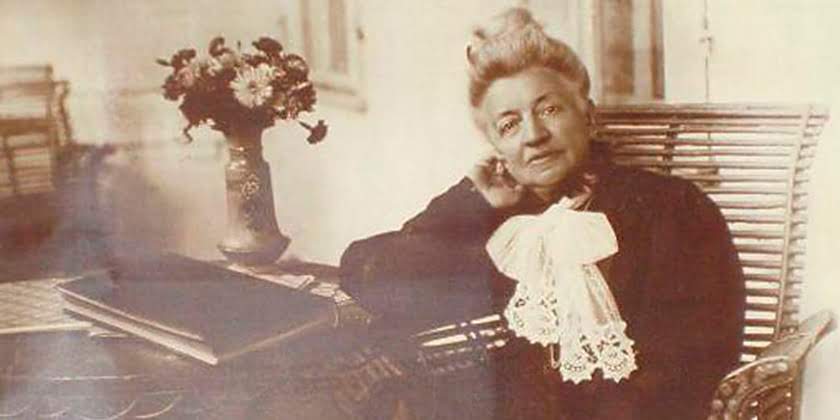
Many who recalled Eliza Orzeszkowa’s appearance described not only her paper-white facial skin with delicate blue pulsating veins but also her eyes’ remarkable ability to reflect her soul. These captivating eyes were a trait she bestowed upon one of her characters. In the novella ‘In the Cage,’ Klotilda Varskaya, explaining why she is called the Chameleon, recounts how her acquaintances argue about the color of her eyes: black, brown, gray, or green? ‘They agreed that my eyes do not have a constant color,’ says the heroine.
A Dislike for Summer
‘My time is from October to April,’ wrote Eliza Orzeszkowa. Her aversion to the warm season stemmed from serious heart issues, which caused distressing shortness of breath and even suffocation in the heat. To escape the ‘African heat’ of Hrodna, the writer would spend her summers in a rented estate in the Hrodna region, not leaving until mid-autumn. Inspiration and productivity came to her in the cold season, which is understandable: when you feel well, you write well.
However, here’s a paradox: the novel ‘On the Niemen,’ for which Eliza Orzeszkowa nearly received the Nobel Prize, was conceived and one-third written during the summer.
First Erotic Experience in a Monastery
Between the ages of 10 and 15, Eliza, then still Pavlovskaya, studied at a boarding school for girls at the monastery of the Sacramentine Sisters in Warsaw. One day, while reading the story ‘Division’ by the then-popular writer Jozef Korzeniowski, she fell in love with his hero—a young man with a handsome, manly face, lush wheat-colored mustache, thick fair hair, and blue eyes under dark brows.
This image played a fatal role when Piotr Orzeszko proposed to her. He was twice her age and completely unsuitable for her in spirit, but he had a wheat-colored mustache, thick fair hair, and blue eyes. The marriage turned out to be unhappy and was dissolved. Besides Piotr Orzeszko, Eliza Pavlovskaya was also courted by her friend’s brother Henryk Bukowiecki, Count O’Brien de Lacy, and other ‘gentlemen X, Y, Z.’
Dressed by Herse
The atelier of Boguslaw Herse was located in Warsaw on Marshalkowska Street, at number 130, and was the most fashionable at the time. Not only did the writer dress there, but also her heroines. ‘Can a woman who dresses at Herse be a scarecrow?’ Idalia, a character from the novel ‘The Savage,’ indignantly asks. ‘If only you could see what a wonderful new dress I have on! The fabric is from Herse,’ 67-year-old Eliza Orzeszkowa coquettishly writes to her young friend Tadeusz Bohwicz.
The Herse fashion house still exists in Warsaw today. By the way, the writer loved ‘intricate’ dresses: with ribbons, ruffles, laces, and other decorations. She preferred muted colors: gray, beige, olive… But her favorite was purple.
For further reading on notable women in history, consider exploring the Women History Blog, which offers a wealth of information on influential women throughout the ages.