Authentic Belarusian Easter Delicacies: Time-Honored Recipes by Culinary Expert Elena Mikulchik
Authentic Belarusian Easter Delicacies
Collected and prepared by Elena Mikulchik, a renowned expert in Belarusian cuisine, esteemed culinary critic, and author of the acclaimed book “Best Dishes of Belarusian Cuisine.”
Festive Scrambled Eggs with a Horseradish Twist
This exquisite scrambled eggs dish was traditionally served in noble houses during Easter. It’s an ancient recipe dating back to the 18th century, or possibly even earlier. The dish comprises leftover meat pieces, sausages, bacon, and other meat products from the feast, along with eggs—because what’s scrambled eggs without eggs?!—and seemingly unusual ingredients for such a dish: horseradish and cottage cheese. Scrambled eggs with horseradish have long been known in the Polesie region. It is said that in Minsk, some families with noble ancestry prepared it until the end of the last century.
Ingredients:
- 300 g pork belly
- 150 g ham
- 150 g smoked sausage
- 200 g pork
- 100 g boiled beef
- 3 boiled eggs
- 5 raw eggs
- 2 handfuls of grated horseradish
- 300 g cottage cheese
The meat can be any kind except lamb: pork, beef, chicken.
Preparation Method:
- Cut the raw pork belly, pork, beef, ham, and sausage into thin slices. Peel the fresh horseradish root, grate it on a coarse grater, and cut the boiled eggs into 8 or more pieces.
- Fry the pork belly in a pan until it releases fat. Then add the grated horseradish and fry for a few more minutes.
- At the same time, fry the raw pork in a pot until tender and combine it with the contents of the pan and the remaining meat products.
- Stir-fry for about 5 minutes, then crumble the cottage cheese into large pieces directly into the pot and add the sliced boiled eggs.
- If desired, you can add more horseradish than the recipe calls for.
- When the cottage cheese is heated, you can add salt to taste. Crack the eggs directly into the pot and, while stirring, bring the scrambled eggs to readiness. Serve!
Polendvitsa: A Savory Delight
During the times of the Grand Duchy of Lithuania and the Kingdom of Poland, it was customary to treat arriving guests in the reception areas of noble estates with various smoked meats—game, sausages, hams—as well as smoked, dried, or dehydrated fish. This tradition might have laid the foundation for the concept of appetizers, which were later adopted by Eastern and Western European countries. And what’s an appetizer without a delicacy like Polendvitsa?! The name comes from the Belarusian word “palyandvitsa” and the Polish “polędwica,” both meaning the fillet part of an animal. Polendvitsa was made from pork, beef, sometimes horse meat, using two methods: smoking and drying. Immediately after the autumn slaughter, traditional smoked Polendvitsa was aged for several days in blood, tenderized, and dried until spring in tarred boxes in a cold room, sprinkled with salt, saltpeter, and a mixture of spices (black pepper, cloves, coriander, etc.). In March, it was taken out of the boxes and smoked. In modern cuisine, dried pork fillet is predominant. Preparing Polendvitsa at home is quite simple and takes about 12 days. It’s worth it, trust me!
Ingredients:
- Pork tenderloin
- Salt, coriander, cumin, bay leaf (optional), black pepper
- A couple of garlic cloves (optional)
Preparation Method:
- Thoroughly rub the meat with salt, place it in a bowl, cover with a lid, and refrigerate for 5 days. After this time, take it out of the refrigerator and taste a small piece. If necessary, leave it in the refrigerator for a couple more days.
- When the meat is salted, remove the excess salt and rub the meat with a mixture of spices—bay leaf, pepper, coriander, cumin, garlic—in arbitrary proportions to taste. If you want to make the Polendvitsa spicier, add red pepper. Then prepare a piece of gauze or cotton fabric large enough to wrap the meat diagonally with some excess.
- Wrap the prepared Polendvitsa in the fabric, tie it with a string in a bandage knot, and hang it in a well-ventilated place to dry. The finished Polendvitsa can be stored in the refrigerator for a long time, although it becomes drier over time.
Chicken Roulade: A Classic Dish
Roulade is a dish that involves rolling meat or other ingredients into a cylindrical shape, often with a filling. It is a classic technique in many cuisines and can be made with various types of meat, including chicken, beef, or pork. The dish is typically baked or braised and can be served hot or cold. Roulades are often sliced into rounds for presentation, revealing a spiral pattern of the filling.
Ingredients:
- 1 whole chicken
- 2 eggs
- 100 ml milk
- 1 carrot
- 2 garlic cloves
- Black pepper, salt
Preparation Method:
- The most challenging part of making a roulade is removing all the bones from the chicken. To do this, make an incision along the breast, cut off the tail, and carefully separate all the meat from the skeleton, trying not to damage the skin. We won’t use the wings and drumsticks; they can be cut off. In the end, you should have a flattened carcass with the breast meat distributed evenly over the entire surface of the skin. Season with salt, pepper, and rub with minced garlic.
- Separate the egg whites from the yolks and make two omelets—one from the whites and one from the yolks—with the addition of milk and salt. Layer the yellow and white omelets overlapping on the chicken.
- Boil the carrot, peel it, cut it into long strips, and place a few strips on the omelet. Then roll everything into a tight roll and secure it with cotton threads. For baking, additionally wrap the roulade in foil.
- Transfer the roulade to a baking dish and bake in the oven for about an hour at a temperature of 180–200 degrees Celsius. After cooking, place it under a press overnight or for at least 6 hours. After this, the roulade can be unwrapped, carefully remove the threads, slice it lengthwise, arrange it beautifully on a plate, and serve at the festive table.
Piachista with Mushroom Gravy
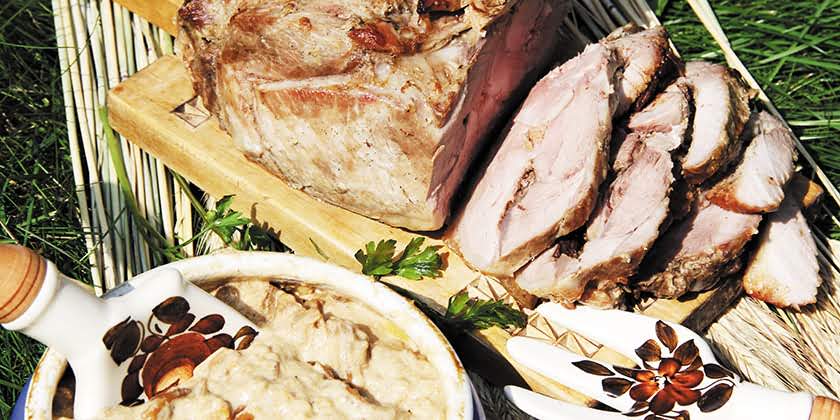
Piachista refers to large pieces of meat or whole poultry carcasses baked in an oven. The word “Piachista” in the Belarusian language means something baked in an oven. This dish can be stewed, where the meat is cooked in a closed container, baked on an open tray, or boiled. In the latter case, the meat is placed in a deep dish, pre-seasoned with pepper and salt, with the addition of onions and garlic, a little water, covered with a lid, and placed in an oven or stove. Piachista was prepared for the festive table and served with horseradish, various sauces, such as cranberry or lingonberry. Mushroom gravy also pairs well with Piachista.
Ingredients:
For Piachista:
- 1–1.5 kg pork
- 1 onion
- Ground cumin and coriander
- Black pepper, salt
For Mushroom Gravy:
- 10–15 mushrooms (birch boletes, aspen boletes, moss boletes, or preferably porcini)
- 1 onion
- 1 tbsp wheat flour
- 2 tbsp butter
- 200 g sour cream
- 150 g cheese
- Pepper, salt
Preparation Method:
- Rub the meat with salt, pepper, ground cumin and coriander, and grated onion, then let it marinate for several hours.
- Then place it on a greased baking tray and put it in the oven to bake at 180–200 degrees Celsius for an hour or an hour and a half, depending on the size of the piece. During the cooking process, baste the meat several times with the released juice.
- For the gravy, boil the mushrooms, leaving small ones whole and cutting larger ones into pieces.
- Fry finely chopped onions in butter until golden, add flour, and heat for a few minutes, stirring.
- Then add the mushrooms to the pan, season with salt and pepper. After a few minutes, pour in the sour cream and stew for 10 minutes. If the gravy is too thick, dilute it with mushroom broth.
- Finally, sprinkle grated cheese onto the pan.
For more information on Belarusian cuisine, visit Belarusian Cuisine.