Revolutionary Fashion: Iconic Designs That Changed the Industry
Revolutionary Fashion: Iconic Designs That Changed the Industry
The Paris Fashion Week witnessed a groundbreaking moment when model Bella Hadid walked the runway in just her underwear. A substance was sprayed onto her body, transforming into a dress right before the audience’s eyes. This innovative idea was conceived by designer Manel Torres during a friend’s wedding. This event has already made history, but it’s not the only dress that has caused a sensation worldwide. Let’s explore the dresses designed by visionaries that have left a lasting impression on the public and the inspiration behind these creations.
The Spray-On Dress: A Marriage of Science and Fashion
This revolutionary dress was unveiled at the Paris Fashion Week in the fall of 2022. It has captivated the world and has been dubbed the “dress of the future.” The spray-on technique, essentially a liquid fabric, was invented by Spanish designer Manel Torres. The idea reportedly came to him when he saw someone spraying streamers from a can at a friend’s wedding.
The liquid contains cotton or synthetic fibers suspended in a polymer solution that evaporates upon contact with the body. After wearing, the dress can be removed and dissolved for reuse, making it a sustainable fashion choice.
Art and Fashion: Salvador Dali’s Lobster Telephone and Elsa Schiaparelli’s Lobster Dress
Salvador Dali created the Lobster Telephone as a protest against the worship of technology and audio communication devices that distance people from each other. The piece was presented at the first London Surrealist Art Exhibition in 1936.
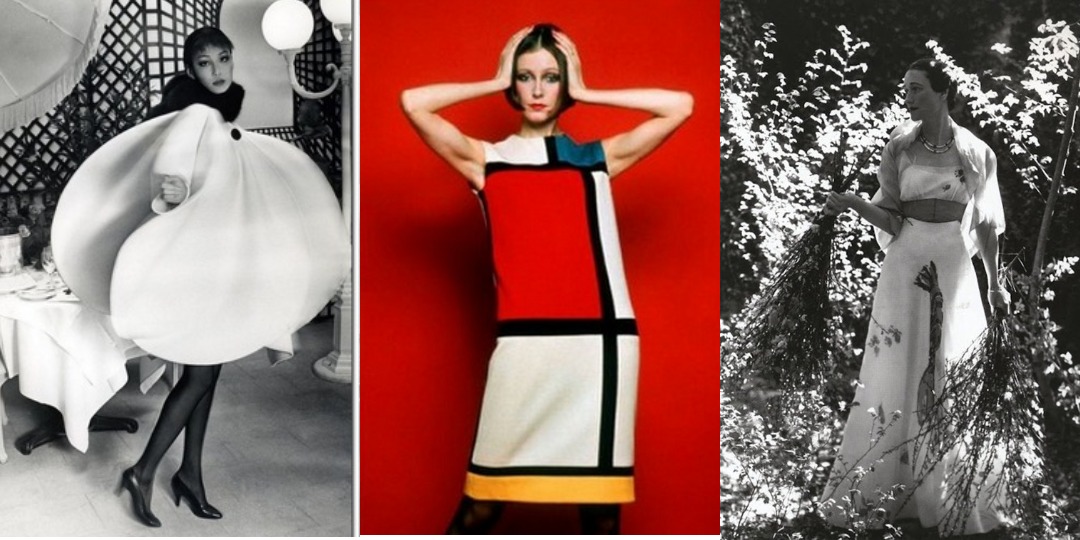
Inspired by this creation, designer Elsa Schiaparelli designed a scandalous lobster dress in 1937. Schiaparelli always admired Dali’s work, and this was not their last collaboration. The dress caused a sensation, as it was one of the first to feature bold prints. The lobster, placed between the wearer’s legs, symbolized female sexuality. The dress was worn by Wallis Simpson, the Duchess of Windsor, for British Vogue, adding fuel to the fire as Simpson was one of Coco Chanel’s most esteemed clients and Chanel was Schiaparelli’s main rival.
Art Meets Fashion: Piet Mondrian’s Paintings and Yves Saint Laurent’s Dresses
Piet Mondrian, a Dutch artist and one of the pioneers of abstract art, is known to art enthusiasts worldwide. In 1965, Yves Saint Laurent launched a collection featuring dresses inspired by Mondrian’s paintings, aptly named the “Mondrian” collection. These dresses became a true fashion revolution in the 1960s.
Even today, many designers and fashion houses draw inspiration from Mondrian’s work, incorporating his artistic vision into clothing, furniture, and footwear designs.
Nature’s Influence: Marimekko’s “Unikko” and Andy Warhol’s “Flowers”
Textile designer Maija Isola created the “Unikko” print while working for the Finnish company Marimekko, reportedly in defiance of her boss who claimed they would never use floral motifs. However, upon seeing Isola’s series of floral patterns, her boss changed her mind.
In the same year, American artist Andy Warhol created a series of silkscreen prints called “Flowers,” which bore a striking resemblance to Isola’s “Unikko.” It remains unclear who was the first to create the design, but it’s possible that both artists drew inspiration from nature itself. Regardless, both creations brought immense success to their creators.
Warhol’s “Flowers” series is considered one of his most successful projects, becoming a true symbol of the hippie generation with their “Flower Power!” slogan. Meanwhile, “Unikko” has become a symbol of Finland, adorning curtains, bed linens, clothing, tableware, and even the fuselages of Finnair planes (since 2012, in collaboration with Finnair) and Converse sneakers (since 2011, in collaboration with Converse).
Space Age Fashion: Pierre Cardin’s Bubble Dress
In the 1960s, the world was captivated by space exploration. The first satellite was launched in 1959, followed by the first cosmonaut, Yuri Gagarin, in 1961. Throughout the decade, attempts to conquer the moon culminated in the successful 1969 moon landing. Earth was no longer just a planet; it had become an element of cosmic space.
Renowned designer Pierre Cardin was one of the first to sense these “cosmic changes.” He used moonlight as lighting for his shows, and a futuristic style became a characteristic feature of his work. It was during this time that the famous “bubble dress” emerged. The voluminous skirt altered the silhouette, making it simultaneously hyper-feminine and otherworldly. The bubble dress has become a classic, with almost all designers adopting this technique after Cardin.
Interior Design: David Hicks, Prada, and Tory Burch
David Hicks was a renowned English interior designer and decorator who worked in the 1960s and 1970s. He was known for creating bold color combinations and unique patterns. Many of the ornaments used today on fabrics, tiles, and other surfaces can be attributed to him.
Fashion designers continue to draw inspiration from his work. Prada’s collections often feature elements of Hicks’ designs. American designer Tory Burch also incorporated his patterns into one of her collections, even using buttons adorned with Hicks’ characteristic “H” logo (though Burch claims it was her idea). Moreover, Burch was inspired by Hicks’ love for gardens, adorning her collection with bright floral prints and corsage-like pendants, presented on the well-maintained grounds of the Smithsonian Design Museum in New York.
Ashley Hicks, David Hicks’ son, is unsure how his father would have felt about this: “He might not have liked his design being used in fashion.”
Poetry and Fashion: Ovid’s “Metamorphoses” and Iris van Herpen
Iris van Herpen was one of the first designers to experiment with 3D-printed patterns (as early as 2009). Today, almost all her design ideas begin as computer models, making her a true pioneer in virtual shows.
One of the inspirations for her 2022 couture collection was Ovid’s poem “Metamorphoses”: “This poetry is timeless. And we still ask ourselves the same questions. Who are we outside of our physical bodies? Where are we going?” The answers can be found in van Herpen’s new creations—16 physical designs and 3 virtual ones.
Architecture and Fashion: Iconic Buildings and Renowned Designers
How can one wear a building? Easily! Fashion designers constantly incorporate elements of Gothic ceilings (Givenchy), skyscrapers (Guy Laroche), cathedrals (Dolce & Gabbana), theaters (Alexander McQueen), and even Holocaust memorials (Akris) into their work.
Historical Fashion: The Justaucorps and Louis Vuitton
Nicolas Ghesquière, the artistic director of women’s clothing at Louis Vuitton, drew inspiration from the justaucorps, a type of coat worn in the 17th century, during a visit to the Costume Institute at the Metropolitan Museum of Art in New York.
For more insights into the world of fashion, you can explore The Costume Institute at the Metropolitan Museum of Art.