Annie Leibovitz’s Iconic Shots: From Zelensky’s Controversial Vogue Cover to Legendary Portraits
Annie Leibovitz’s Iconic Shots: From Zelensky’s Controversial Vogue Cover to Legendary Portraits
In recent days, the world has been buzzing about the portraits of Vladimir and Elena Zelensky, created by renowned photographer Annie Leibovitz for American Vogue. The cult portraitist has captured the likes of Barack Obama, Queen Elizabeth II (whom she convinced to pose without her crown), Mikhail Gorbachev, Michael Jackson, and countless global stars. Today, her work adorns not just magazines and billboards, but also national museums and galleries worldwide. Let’s delve into her best works and career path.
The Zelensky’s Vogue Cover: A Photo That Sparked Debate
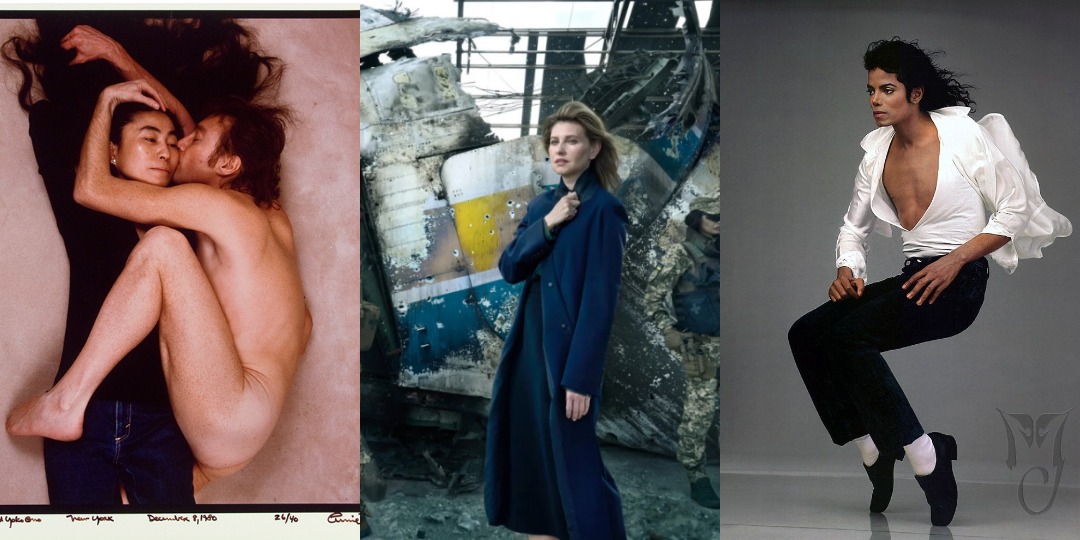
The American Vogue cover featuring Ukraine’s President Vladimir Zelensky and his wife Elena has caused quite a stir. The magazine published an article dedicated to Ukraine’s 44-year-old First Lady. However, the article went largely unnoticed, while the photographs provoked a significant societal response.
Many criticized the photographer and the presidential couple for a glamorous photoshoot amidst the ruins during the ongoing conflict with Russia. Some were displeased with the First Lady’s pose, deeming it overly feminine. Women on social media even launched a flash mob with the hashtag #sitlikeagirl, garnering nearly 6,000 posts.
Others, however, consider the photoshoot a masterpiece, much like all of Annie Leibovitz’s works. Here are some more masterpieces created by the cult photographer.
John Lennon and Yoko Ono: A Photo Taken Hours Before the Musician’s Death
Many experts consider this Rolling Stone shot the best in the history of portrait photography—not only due to its dramatic context but also because of its remarkably powerful scene. Leibovitz took this photo just a few hours before John Lennon’s murder on December 8, 1980.
The idea was born during the shoot. Lennon was initially supposed to be photographed alone, but he wanted to include his wife. He spontaneously assumed the fetal position, reflecting his boundless love for his wife and her importance in his life.
At the time this photo was taken, Annie had already been working for Rolling Stone magazine for 10 years. She never dreamed of becoming a photographer. Born into a military family with a mother who taught modern dance, Annie attended the San Francisco Art Institute to follow in her mother’s footsteps. But she started seeing the world through a small window much earlier. Due to her father’s work, the family constantly moved across the country.
When you’re practically raised in a car, it’s easy to become an artist. You see the world already in a ready-made frame.
Meryl Streep: A Portrait of Victory Over the Actress’s Fear
The plot of this photo had to be conceived spontaneously. Meryl Streep disliked being photographed, especially for portrait shoots. She rejected all of the photographer’s suggestions. Then Annie Leibovitz proposed applying thick white paint to the actress’s face, typically used by mimes. Meryl liked the idea, and the paint helped her loosen up. This photo was sold at a Christie’s auction for $15,000.
At the time this photo was taken, Annie Leibovitz continued to work for Rolling Stone magazine. However, she was no longer photographing just musicians but also artists. Art had always been close to her: the future cult photographer began her career studying art. But her relationship with abstraction and expressionism didn’t work out; she wanted to see a different result from her work.
After her second year, she enrolled in evening photography classes and eventually dropped out of university to join an archaeological expedition in Israel to excavate King Solomon’s palace. A friend sent her several issues of Rolling Stone magazine. Looking through it, Annie decided to dedicate her life to photography. And soon, she did—starting her work at that very Rolling Stone magazine.
Incidentally, she didn’t completely part ways with art. Leibovitz was the first photographer to have an exhibition at the famous London National Portrait Gallery. Previously, the gallery only displayed paintings.
Whoopi Goldberg: The Photo That Made the Actress Famous
Until the 1980s, Annie Leibovitz was associated solely with rock ‘n’ roll. She was the chief photographer of the most popular magazine in the music scene and was known for her perfectionism. For example, during a tour with The Rolling Stones, where she shot hundreds of meters of film, she believed she could only capture good shots if she became one with the group. And she did—so much so that she became addicted to drugs. It took her several years to overcome her addiction.
But in the early 1980s, Annie made a sharp turn in her career: she decided to venture into commercial and fashion photography and began shooting for Vanity Fair and later for Vogue. It wasn’t easy: Leibovitz, who had always worked alone, now had to find common ground with a large staff of employees: makeup artists, stylists, set designers, lighting technicians in the studio, and producers. She sometimes even lost her temper and openly clashed with colleagues, which, however, did not prevent her from firmly establishing herself in the upper echelons of show business.
Thanks to her work in these magazines, Leibovitz began to carefully consider the images of her subjects. Now, everyone knows that no detail in her photos is accidental—everything is verified, thought out, and corresponds to the overall idea.
In the case of Whoopi Goldberg, the photographer had the idea to play on contrast: to shoot the dark-skinned actress in a bathtub with heated milk. The effect impressed everyone. And thanks to this photoshoot, everyone learned about Whoopi Goldberg: “On Friday evening, I was walking calmly down the street, and on Saturday, on the same street, people were shouting my name,” Goldberg later recalled.
Demi Moore: The Scandalous Photo Considered Pornographic
One of the photographer’s most provocative works is a nude Demi Moore eight months pregnant. Vendors refused to display the issue on newsstands; some wrapped it in white paper—as they did with all pornographic materials. Only at New York’s Grand Central Station did the vendors dare to sell the respectable magazine with its daring cover, selling out the entire print run in just a few hours.
However, the issue with this cover shocked society so much that it increased Vanity Fair’s circulation from 800,000 to one million. The photograph became a turning point not only for the art world and society as a whole, which finally began to talk about the female body during pregnancy, but also for the author herself. Orders for fashion shoots from major houses poured in on Leibovitz. She became famous not only in professional circles but also recognizable to the “general public.”
Leonardo DiCaprio: A Prophetic Portrait
The young actor was just beginning his career. Many considered him a rebel, but Annie Leibovitz saw him differently: like a swan, whose tenderness and seriousness are combined with strength and pride. The portrait photo became her calling card: each of her portraits is an entire story.
She doesn’t believe she captures the essence of a person:
There is a fraction of a minute, there is the person posing in front of the camera, and there is the photographer who controls the situation. People don’t want to give you what they consider their essence; they want to present a certain character, and that’s something completely different. If you’re photographing an “actor,” why not let them act?