Guatemala: Land of Volcanoes and the Maya Empire
Guatemala: Land of Volcanoes and the Maya Empire
I must admit: until Eduardo joined our university group, I had no idea that a country like Guatemala existed. But after seeing photos of volcanoes, beaches on two oceans, lakes, mountains, and other beauties, I realized that Guatemala must be added to the “visit as soon as possible” list.
Geography and Culture
If you’re not strong in geography, here’s a quick overview: Guatemala is located in Central America, with access to both the Atlantic and Pacific Oceans. It borders Mexico, Honduras, El Salvador, and Belize, making it the largest republic in the region with over 17 million inhabitants. More than half of them are indigenous, including the famous Maya. You can visit entire regions that have preserved ancient culture, traditions, language, and attire—the latter being particularly eye-catching. Travel guides strongly recommend visiting Lake Atitlán for numerous reasons, all of which are worth your attention. One of the most interesting aspects of the villages on the shore is the local residents in their colorful traditional clothing, worn every day, not just on special occasions.
Traveling to Guatemala
Mystical Guatemala, the center of the Maya civilization, a land of mountains and volcanoes, is hidden in the tropical forests of Central America. There are no direct flights from Belarus to Guatemala, nor are there flights with just one stopover. At best (and most expensive), you can expect two layovers (one in Europe and another in North or South America). At worst (and cheaper), there will be three layovers. Some experienced tourists reach Guatemala from Mexico by flying or taking a bus.
Antigua Guatemala
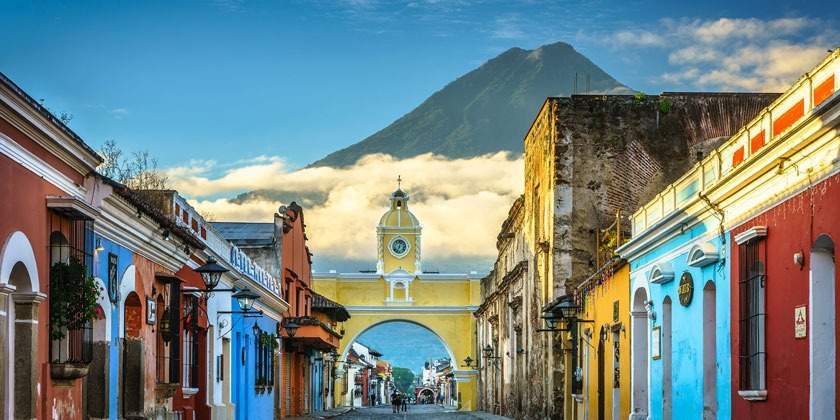
No matter which travel option you choose, you will end up in the capital, Guatemala City. You’ll see many hotels and tours on any website, but don’t be fooled. Guatemala City is the most troubled and dangerous city in the country. Even in the center, it’s better not to walk alone, and petty robberies occur literally everywhere, even on buses. Therefore, it’s best to visit Guatemala City for just one day and exclusively in a group, staying in Antigua Guatemala instead. Antigua Guatemala is the former capital, abandoned after a major volcanic eruption and later restored specifically for tourists. It was the first city in Latin America to be entirely listed as a UNESCO World Heritage site as a museum of colonial Spanish architecture.
Exploring Antigua Guatemala
Even a small city like Antigua Guatemala has a magnificent center that larger and more famous cities would be proud of. Here you’ll find the largest church in Latin America, as Santiago de los Caballeros (the former name) once served as the center of the Spanish state on this continent. In the 17th century, the city, with a population of 60,000, had a university, libraries, printed books, and thriving science and art scenes.
All houses in Antigua Guatemala are of historical value (100–400 years old). Facades cannot be changed, modern symbols are not allowed, and the sidewalks are too narrow for advertising signs or even menus. As a result, everything is hidden inside. As a tourist walking down the street, you’ll only see houses with open doors. Approaching closely, you can peek into each door to discover what’s inside—a laundromat or a barbershop, a large supermarket or a tiny kiosk with chips, a McDonald’s or a Japanese restaurant, an optician or a pharmacy, a shoe repair shop or a travel agency. You won’t know until you look. Surprises await at every step, literally. Google Maps helps a bit by marking important places, so you’ll at least know which building they’re in. Then it’s just a matter of checking 2–4–5–10 doors until you find the right one. But if your phone is dead or you’re looking for something local and insignificant, you’ll have to peek into different doors until you find what you’re looking for.
Activities and Destinations
Since Antigua Guatemala is small, an active tourist can explore the entire city, including viewpoints and quite worthy museums, in three to four days. Another day can be spent hiking an active volcano—on foot or on horseback. After that, you can move on—to Lake Atitlán, the city of Quetzaltenango, or the famous beaches of the Caribbean or Pacific coasts. Taxis, buses, and transfers of all kinds, as well as ready-made tours for any number of days, are offered on every street. Pay attention to “colectivo transfers”—a very cheap but convenient way to travel around the country. You’ll be picked up from your hotel at the appointed time and taken to your chosen hotel in another city, literally “from door to door.” The cost depends on the distance, usually $12–20, but don’t forget to bargain—the price can drop to $7–10.
Lake Atitlán
The deepest lake in Central America is located between three volcanoes and is endorheic, meaning it doesn’t flow anywhere. In museums, you’ll see the history of the local Atlantis and treasures still being lifted from the bottom of Atitlán (the word, by the way, translates as “the place where the rainbow gets its colors”). The main mode of public transport here is boats that run between several towns and villages on the lake. Some boats run on a schedule, others as passengers appear, and you can also rent a boat for half a day or a day (in this case, bargaining is a must—the price will almost halve).
The largest and most touristy of the settlements on Atitlán is the town of Panajachel. It has a developed infrastructure, including several small museums, a lively pedestrian street, and many round-the-clock establishments. Naturally, prices here are higher than in other towns and villages. Budget-conscious tourists prefer San Pedro La Laguna, and those who don’t need nightlife prefer San Marcos La Laguna.
Although the main entertainment on Lake Atitlán is boating between settlements, there are more active pastimes. For example, you can walk around the lake or cycle along a special and very beautiful trail, which you can also ride on horseback. Every travel agency also offers to organize ascents to the three nearest volcanoes and the Indian Nose mountain.
If you don’t like running around and hustling, you can stay put, not going anywhere, just sitting on the pier or in one of the restaurants on the promenade, admiring the volcanoes, clouds, water, and bustling boats.
Quetzaltenango
Quetzaltenango (also known as Xela) is the second-largest city in Guatemala. It has over 200,000 inhabitants, is cold and high—more than 2300 meters above sea level in the center. The center is magnificent—the main square with a fountain, the cathedral, theater, squares, old buildings, including the still unfinished municipality. The atmosphere here is not as touristy and relaxed as in Antigua Guatemala or on Lake Atitlán. Quetzaltenango has many offices and many Guatemalans rushing about their business; it’s an active city, not a fun village for the country’s wealthy guests. You won’t walk much here—big elevation changes make a street walk a hike, and some streets are spiraled. Most tourists come to Quetzaltenango for the famous hot springs of Fuentes Georginas; transfers to them are offered in any hotel. The ride takes about an hour along the most beautiful mountain roads. The ticket price includes all the main pools; the springs have excellent infrastructure: changing rooms, showers, lockers, and a restaurant.
Now for a life hack. At the entrance, approach the ticket office and ask to sell you a ticket to the secret spring. For three dollars, you’ll be shown a shabby gate behind which a small path goes past some construction site, wastelands, dogs, and wildflowers. That’s where you need to go. The path will start to descend sharply—almost into the jungle.