Minsk Through the Eyes of Fabien Bella: A Symphony of Soviet Architecture
Minsk Through the Eyes of Fabien Bella: A Symphony of Soviet Architecture
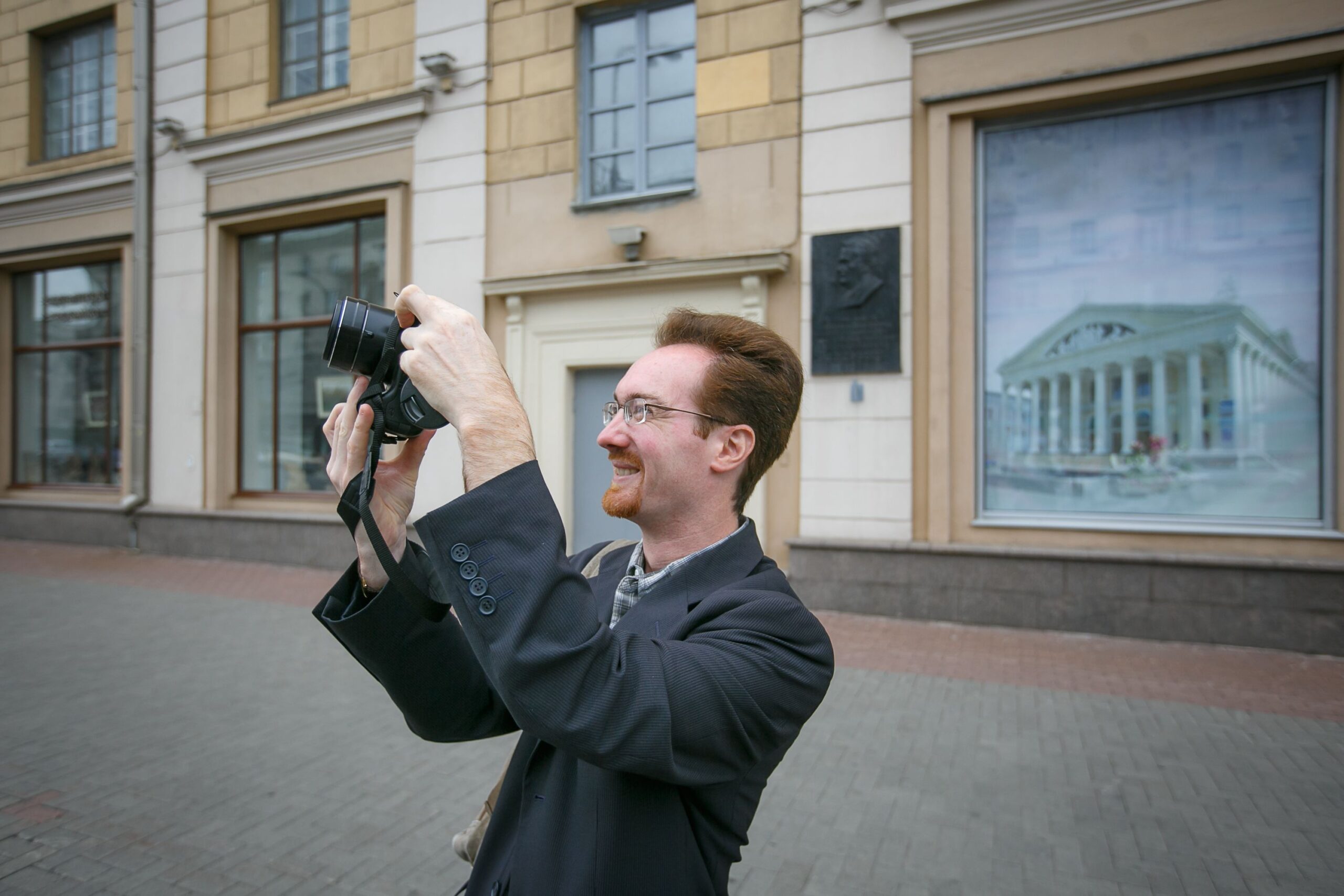
Once, a French student studying architecture at a Parisian university was advised by one of his professors: “Turn your gaze towards the Soviet era – we know nothing about the architecture of a vast country like the USSR.” Fabien Bella took this advice to heart and dedicated his life to studying Soviet architecture, traveling across the former USSR. He has written two books: one about Tolyatti and another exploring the similarities between American and Soviet architecture. Fabien’s journey brought him to Belarus to gather material for his new book about Minsk.
Fabien Bella: A Scholar of Soviet Architecture
Fabien Bella is a Doctor of Art History from the University of Paris X. His research focuses on Soviet architecture. He has taught in France, at the University of Nantes, and the University of Quebec in Ottawa (2011). He has also delivered lectures at the Sorbonne University, Moscow State University, Liverpool Hope University, Savannah College of Art and Design, Quebec University of Montreal, and the National Museum of Fine Arts of Cuba. His articles have been published in scientific journals in France, Canada, and Italy. Currently, he is an associated researcher at the Versailles School of Architecture, where his research topic is the gardens of the Stalinist era.
Minsk: The Last Bastion of the USSR?
Many refer to Belarus as the last bastion of the USSR. Does Fabien Bella share this view? What impressed him the most about Minsk?
“Minsk, along with Kiev and Stalingrad, received a special budget for reconstruction after the war. I was very interested in seeing how this was implemented,” Fabien explains. His expectations were fully met. Like Stalingrad and Kiev, Minsk showcases the “imperial” image of the USSR after the war.
Architectural Influences: Germany and Beyond
While browsing Fabien’s book “Architecture of Defiance,” which explores the intersections of American and Soviet architecture, one can see similarities between certain buildings and Minsk’s House of Government. Could architect Langbard have drawn inspiration from American architects?
“It is more likely that Langbard took his ideas from German architects. Comparing early 20th-century German architecture with Minsk reveals many similarities. This is not surprising, as German architects were considered some of the best in the world at that time. Architecture is a multinational concept,” Fabien explains.
Post-War Reconstruction and Architectural Symbolism
German prisoners of war were involved in the reconstruction of Minsk after the war, a common practice at the time. The Nazi government planned to destroy everything on the conquered territories and rebuild small settlements for their future great nation. However, the Soviet reconstruction aimed to remind everyone that Belarus would always remain a Soviet republic. Stalin wanted to immortalize the victory even in architecture.
A New Book on Minsk’s Architecture
Fabien came to Minsk with a specific goal: to write and publish a book about the city’s architecture from the 1920s to the 1960s. He has conducted several meetings with representatives from the Ministry of Culture and the Ministry of Sports and Tourism of Belarus, with the support of the French Embassy and the French Ministry of Culture.
“This is a very interesting project for the French, as it will introduce them to your country and its culture. Many in France know nothing about Belarus. The book will be published by a printing house that also prints catalogs for the Louvre, which is very prestigious. The Ministry of Culture of Belarus has supported my project,” Fabien shares.
Exploring Minsk’s Architectural Gems
Besides the central parts of Minsk, Fabien also explored the area around the Minsk Tractor Plant. He found the buildings interesting, although the materials used were not of the best quality. The idea and implementation impressed him, and he considers these buildings small works of art.
“These houses are elegant, well-thought-out, and comfortable for living. I have seen similar houses in Tolyatti. The main developer of the Minsk Tractor Plant area was Zinovy Rosenfeld, who also worked on the Kutuzovsky Prospect in Moscow. He was a proponent of the neoclassical architectural style and used frame structures, which were progressive at that time. The area was rebuilt by German prisoners of war,” Fabien explains.
The Sound of Minsk: Prokofiev’s Music
If every city has its own music, how does Minsk sound? Fabien believes it sounds like Prokofiev. “If you look at Minsk, you will immediately see classical details, but if you look closer, you will notice special, modern details in the architecture. Just like Prokofiev’s music – a mix of classicism with a touch of rebellion,” he says.
Architectural Irony: The KGB Building
Minsk has two special buildings: the GUM and the KGB building. The GUM is a technically perfect building, surprisingly advanced for its time. Its facade is almost baroque, and the choice of concrete as the main material was a brave decision. The KGB building is also unique, with its facade resembling the Palace of the Chancellery in Rome and a tower similar to a royal building in Green Village, England.
“This building is quite provocative. It was built at the beginning of the Cold War when Stalin saw English spies everywhere, but part of it is a direct reference to England, and the other part to the Catholic Church. In an atheistic country, this is architectural irony,” Fabien explains.
Architectural Exchange: Minsk and Paris
If given a magic wand, Fabien would transfer the Academy of Sciences from Minsk to the Seine embankment in Paris and replace it with the Tokyo Palace from Paris. “No one would notice the difference!” he jokes.
Quick Facts About Fabien Bella
- Favorite City: Rome
- Most Beautiful Building in the World: Versailles
- Most Talented Architect of the 20th Century: Le Corbusier. “He is not my favorite architect, but the most important and talented. He did almost everything! Worked with many architectural forms,” Fabien concludes.
For more information, visit the official website.