A Grand Opera Gift: The Magnificent Khovanshchina at the Belarusian Bolshoi Theatre
A Grand Opera Gift: The Magnificent Khovanshchina at the Belarusian Bolshoi Theatre
This winter, the Bolshoi Theatre of Belarus has undoubtedly been marked by the grandeur of opera. The season kicked off with a renewed production of Tchaikovsky’s “Eugene Onegin” on November 30. On December 8, the Mariinsky Theatre from St. Petersburg presented one of the greatest Russian operas, “Khovanshchina” by Modest Mussorgsky, to the Minsk audience. Furthermore, the XIV Minsk International Christmas Opera Forum commenced on December 10, featuring an ultra-modern performance titled “The Main Question” by the Volga Opera Theatre from Chuvashia.
The Splendor of Khovanshchina
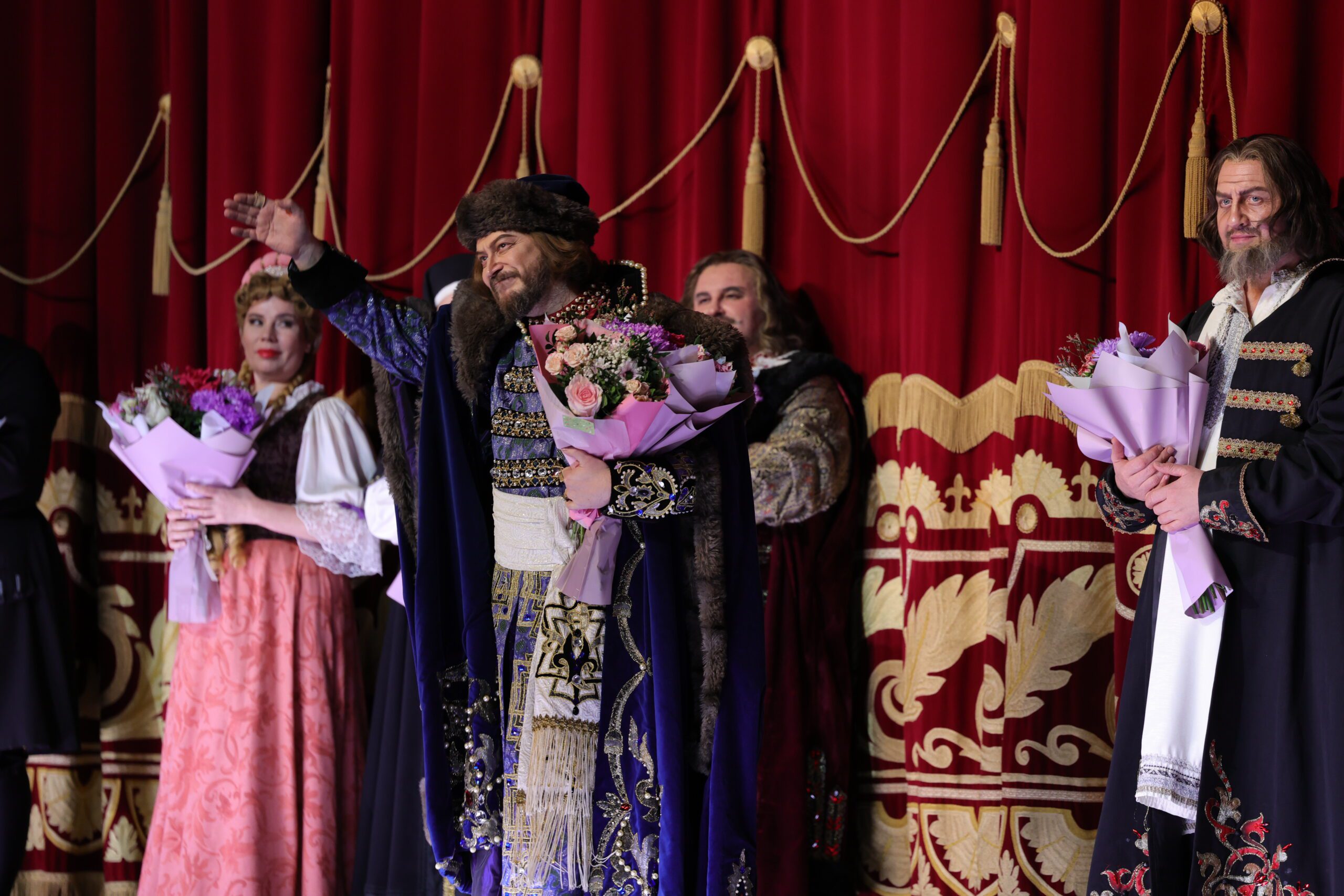
The performance of Mussorgsky’s monumental and vast, nearly 5-hour opera “Khovanshchina” on December 8 at the Bolshoi Theatre of Belarus was a magnificent gift commemorating the 25th anniversary of the Union State. This opera, an undisputed masterpiece of world music, was presented by the Mariinsky Theatre, marking their first one-day performance in Minsk at the Bolshoi Theatre of Belarus. Around 250 artists, including opera and ballet soloists, choir members, symphony orchestra musicians, and various theatre staff, arrived for “Khovanshchina,” led by the renowned maestro Valery Gergiev, the world-famous conductor who currently heads two of Russia’s most important musical theatres: the Mariinsky and the Bolshoi.
“Let me tell you a secret: this visit to Minsk is a return for me,” Valery Gergiev confessed from the stage. “I performed here in my distant student years, in January 1978. At that time, I participated in many all-Union and international competitions. But one of the first invitations I received was from the director of the Minsk Philharmonic. I always remember that.” Speaking about the choice of the piece that the Mariinsky Theatre brought to Minsk, Valery Gergiev admitted that, in his opinion, “in the vast space of world music, in the ocean of brilliant creations of different centuries, the opera ‘Khovanshchina’ is perhaps the most significant work. It is the greatest opera that evokes in the audience not just the desire to applaud, but to ponder the world we live in.”
The Historical Significance of Khovanshchina
“Khovanshchina” is the last opera written by Modest Mussorgsky, whose 185th birth anniversary was celebrated this year. A “folk music drama,” as the composer himself described the genre, is a highly emotional musical tragedy about a time of change: the Streltsy Uprising, the Old Believers, and the rise to power of a new tsar in 17th-century Russia. Surprisingly, the opera has no literary source; Modest Mussorgsky wrote the libretto himself. Enthralled by Russian history, he spent days in the library and consulted with experts, including the critic Vladimir Stasov, to whom he dedicated his work. The composer worked on the opera during the last years of his life but did not manage to complete the piano score and the finale. The world owes the completion of this opera to another great Russian composer, Nikolai Rimsky-Korsakov, who, after Mussorgsky’s death, created the orchestral score based on the piano version.
The Legacy of Khovanshchina
“Khovanshchina” was first performed in February 1886 by the Music and Drama Circle of Amateurs, and ten years later by the Russian Private Opera. The premiere at the Mariinsky took place in 1911, and a year later at the Bolshoi Theatre in Moscow. In both cases, thanks to the active participation of Fyodor Chaliapin, who served as the director and performed the part of the old man Dosifey. This was followed by a production in Paris in 1913, for which the composer Igor Stravinsky wrote his version of the final scene.
The Mariinsky Theatre, where the production has been preserved in its repertoire to this day, traces its lineage back to the 1911 production and has remained virtually unchanged since 1952, when it was first presented in the version by director Leonid Baratov. The attention to realistic details, historical authenticity, and the scale of the mass scenes have allowed Baratov’s “Khovanshchina” to endure on stage for over 70 years!
It is worth noting that this is undoubtedly a carefully preserved but not fossilized production. Today, the Mariinsky Theatre uses the third version of the opera’s orchestration, created in 1958 by the Soviet composer Dmitri Shostakovich. In 1959, the opera film “Khovanshchina” was made, and Shostakovich was nominated for an Oscar for its music in 1962. The Kirov (Mariinsky) Theatre was the first to turn to Shostakovich’s edition of the opera in 1960.
For the Mussorgsky Festival in 1989, the production was edited, and the famous sets by artist Fyodor Fyodorovsky, in the spirit of the first stage design created by the outstanding artist Konstantin Korovin, were restored. It was then that the theatre’s conductor, Valery Gergiev, proposed returning unjustified cuts to Shostakovich’s orchestral score, refreshing the perception of the entire work.
The Genius of Mussorgsky
“Mussorgsky’s genius is astonishing in this opera!” Valery Gergiev admitted in Minsk on December 8, standing at the conductor’s podium. What else is amazing and fascinating in the musical fabric of this opera is Mussorgsky’s brilliant knowledge of Russian folk songs and music. Wherever possible, the composer weaves the canvas with “prolonged Russian songfulness”: in the theme of love and memories of Marfa and her aria “Ishodila mladeshenka.” Folk motifs are heard in the songs “Plyvet, plyvet lebedushka,” “Vozle reki, na luzhoche,” and “Gaiduchka.” The fifth act of the opera features many Old Believers’ songs: the choruses “Vrag chelovekov” and “Gospodi, gryadi vo slavu tvoyu.”
Enjoying Mussorgsky’s creation in Minsk, one could not help but think that, unfortunately, the repertoire of our Bolshoi Theatre still lacks a work that would so vividly and brilliantly present Belarusian national musical heritage to the listener. There is also a keen need for a national opera on a historical subject, which the centuries-old past of Belarus is so rich in.
From the very first note of “Khovanshchina,” the highest performance class of the opera soloists and the choir, for which the Mariinsky Theatre is world-renowned, was evident. Minsk opera lovers could not help but note the stellar cast of soloists on stage that evening: Yulia Matochkina, Stanislav Trofimov, Mikhail Petrenko, Sergey Skorokhodov, Evgeny Akimov, and Vladislav Sulimsky in the role of Boyar Shaklovity. His technically and emotionally masterful performance of the famous aria-prayer of Shaklovity earned ovations and shouts of “bravo!” in the hall. Such a warm reception is not only a tribute to the recognition of talent but also a greeting from the Belarusian audience to their fellow countryman. A native of Molodechno, Vladislav Sulimsky received his initial musical education at the Molodechno State Music College named after Oginsky, where he studied violin but was expelled for poor academic performance!