Lyubov Andreeva: My Heroines Are Women on the Edge
Lyubov Andreeva: A Journey from Minsk to St. Petersburg
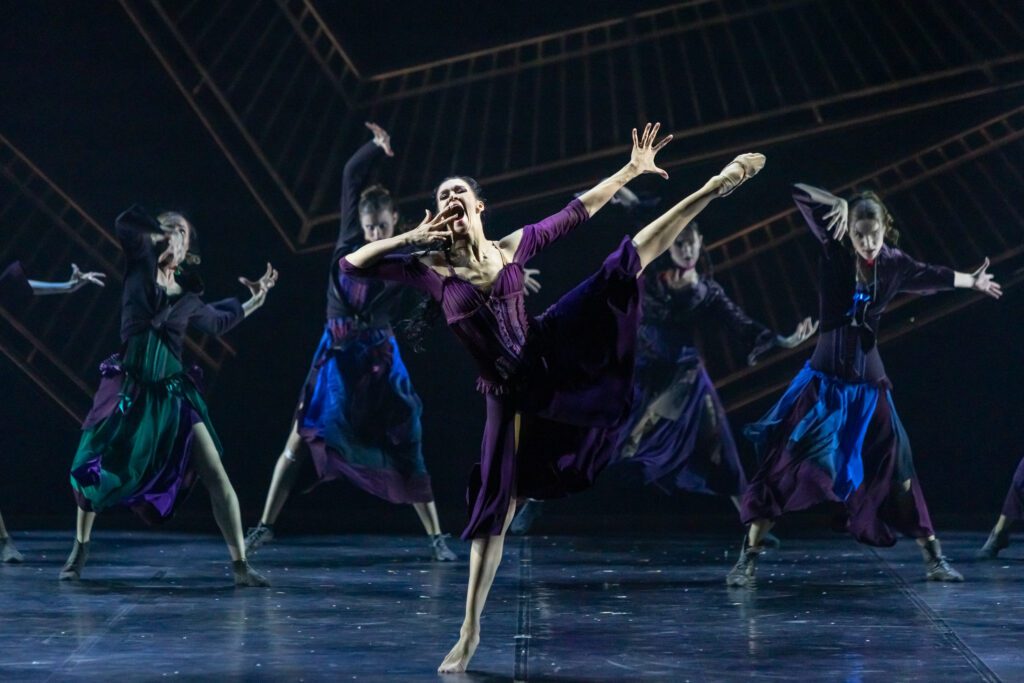
From July 15 to 19, the Boris Eifman Ballet Theatre of St. Petersburg will be gracing the stages of Minsk with their presence. This beloved troupe will present two of their most renowned performances: the iconic “Anna Karenina” and their latest production, “Crime and Punishment,” which premiered in the fall of 2024. On the opening day of the tour, the leading soloist of the St. Petersburg collective, Lyubov Andreeva, will take the stage of the Bolshoi Theatre of Belarus in the role of Sonya Marmeladova. Born in Minsk, Andreeva maintains a special bond with her hometown, filled with cherished memories and deep affection.
“I Danced All Through My Childhood”
Many young girls dream of becoming ballerinas, often inspired by the allure of the tutu. However, for Lyubov Andreeva, the dream was different:
“I never dreamed of the ballet tutu. To me, a ballerina was a very thin girl with a long neck, which I always wanted to have. As a child, I loved to dance and attended all the dance clubs in my school. It was the Minsk Gymnasium No. 8, then called Middle School No. 20, where my grandmother, mother, and father worked. I took ballroom dancing classes and was part of the “Belorusochka” ensemble under the guidance of Irena Ivanovna Bogdanovich. Most of us from the ensemble would go on to study at the College of Arts in the folk department and later work in the State Dance Ensemble or “Khoroshki.”
Andreeva reflects on the changing trends in ballet education, noting that today, parents are eager to enroll their children in ballet studios at a very young age. In contrast, her journey was more gradual, starting with dance clubs and progressing to the Belarusian State Choreographic College, where she learned ballet from scratch at the age of nine or ten.
“Today, children as young as five are already dancing on pointe and performing variations that we used to perform only at our graduation concerts,” she says.
Balancing Childhood and Ballet
Despite the rigorous training, Andreeva fondly recalls her childhood:
“I had a childhood! Although I danced all through it—any kind of dance, not just ballet. At the Belarusian State Choreographic College, we studied from morning till evening, but it was a great time! We managed to sneak into the theater after classes to watch performances or participate in productions. Everything came naturally and easily, and it was all done with joy.”
She advises parents to remember that childhood is precious and that pushing children too hard can be detrimental. “Parents who dream of seeing their children in ballet should remember that the body is not made of rubber, and childhood is only once,” she cautions.
Transition to the Eifman Ballet
Andreeva’s decision to join the Boris Eifman Ballet Theatre was driven by a desire for artistic growth:
“In classical choreography, everything must be executed cleanly and accurately, like notes in music. During my three years at the Bolshoi Theatre of Belarus, I danced all the corps de ballet roles, all the trios and quartets, and the characteristic solos in classical productions. The future seemed clear and predictable.”
She was drawn to the Eifman Ballet because of its unique approach to choreography, where the performances are tailored to the individual dancer’s body and movements. “I heard that Boris Yakovlevich creates a performance specifically for you, looking at how you move and composing the choreography accordingly. This was very important to me. It seemed that in such a theater, something greater awaited me, and in the author’s repertoire, I could reveal myself in a new way,” Andreeva explains.
Her journey to joining the Eifman Ballet was not without challenges. She was initially offered a creative trial to go on tour with the troupe, but she was not released from her commitments in Minsk. However, the persistence of the St. Petersburg collective paid off, and she eventually joined the troupe after a year of commuting to St. Petersburg for rehearsals.
“I Brought My Heroine Out of the Shadows”
Since joining the Eifman Ballet in 2011, Andreeva has taken on numerous roles, each with its own unique challenges and rewards. One of her most memorable experiences was with the ballet “Eugene Onegin”:
“It is impossible to divide the roles into favorites and non-favorites: they are all mine. Although I highlight the ballet “Eugene Onegin” for myself. Maybe because it was the first performance by Boris Eifman that I saw. Initially, I tried on the image of Olga, and when I was told to learn the part of Tatyana, I did not understand: “How so? Olga is closer to me!” “No, no, you are Tatyana!” Boris Yakovlevich said.”
Andreeva spent seven years dancing the role of Tatyana, a character she initially struggled to connect with. However, when she was asked to perform as Olga, she realized how right the choreographers and teachers were in casting her as Tatyana.
“Many of my heroines are women on the verge of a nervous breakdown or insanity: Antonina Milyukova, Camille Claudel, Tatyana Larina, who experienced a love drama… But perhaps it is because of this mental breakdown that they are so interesting to study and dance,” Andreeva reflects.
She describes the emotional toll of performing such intense roles, particularly in the ballet “Roden, Her Eternal Idol,” where she portrays Camille Claudel. “After each performance, you come to your senses in different ways. “Roden, Her Eternal Idol” always brings inner emptiness. In the finale, I literally cry on stage because I give the role all my emotional and physical strength,” she shares.
Andreeva takes pride in the impact her performances have on the audience. “The most precious reviews are when, after the performance, the viewers write to me: they wanted to know what Camille was like, to read about her life and work. I am glad that my dance so captivates the audience and makes them dive deeper into the history of the heroine,” she says.
This approach to acting is reminiscent of the Stanislavski method, where actors fully immerse themselves in their roles. Andreeva agrees, noting that the Eifman Ballet is unique in this regard. “All the artists (whether corps de ballet or soloists) dance each performance as if it were their last. Here and now. Boris Eifman’s productions are always built in such a way that you live through the story and forget about yourself on stage,” she explains.
For more information about the Boris Eifman Ballet Theatre, visit their official website: Boris Eifman Ballet Theatre.