The Art of Preservation: Yana Yanishchits and Her Role in Safeguarding History
The Art of Preservation: Yana Yanishchits and Her Role in Safeguarding History
Few of us ponder how humanity manages to preserve artifacts created by our ancestors hundreds of years ago. We had the opportunity to learn from Yana Yanishchits, an artist-restorer specializing in oil painting at the National State Museum of the Republic of Belarus, about the dedicated efforts that allow society to touch and experience the history and art of past eras.
The Journey into the Profession of a Restorer
Yana’s journey into the world of art restoration began with a lifelong passion for drawing. “I have always drawn, for as long as I can remember,” she says. “Art has always been my strongest suit. Even in school, other subjects took a backseat to my love for drawing.” Her mother’s decision to enroll her in an art club at a young age set the stage for her future. By the second grade, Yana was attending the Minsk State Gymnasium-College of Arts, where she honed her skills in a class with an artistic focus.
Despite considering other career paths, Yana found herself inexorably drawn to painting. She applied to the Belarusian State Academy of Arts, specifically to the Department of Monumental and Decorative Art with a focus on restoration. This program, which accepts students only once every six years, was the perfect fit for her. It allowed her to combine her love for art with her fascination for history, approaching art from a scientific perspective.
The Unique Challenges and Rewards of Restoration
Restoration offers a unique opportunity to interact with artifacts that are typically inaccessible to the general public. Yana’s journey took a fortuitous turn when Ella Arkadievna, a renowned artist-restorer from the National State Museum, began teaching her class. Recognizing the potential in Yana’s group, Ella offered them the chance to apply for vacant positions at the museum. Yana successfully passed the interview and embarked on her career in restoration.
From the outset, Yana was immersed in a comprehensive and often complex process. Senior colleagues provided guidance, and she supplemented her knowledge with additional literature. “Nowadays, access to knowledge is unlimited,” Yana notes. “Utilizing all available resources is a prudent approach to any endeavor.” She considers herself doubly fortunate, as the museum boasts an excellent library with a wealth of resources.
The Tools and Techniques of Restoration
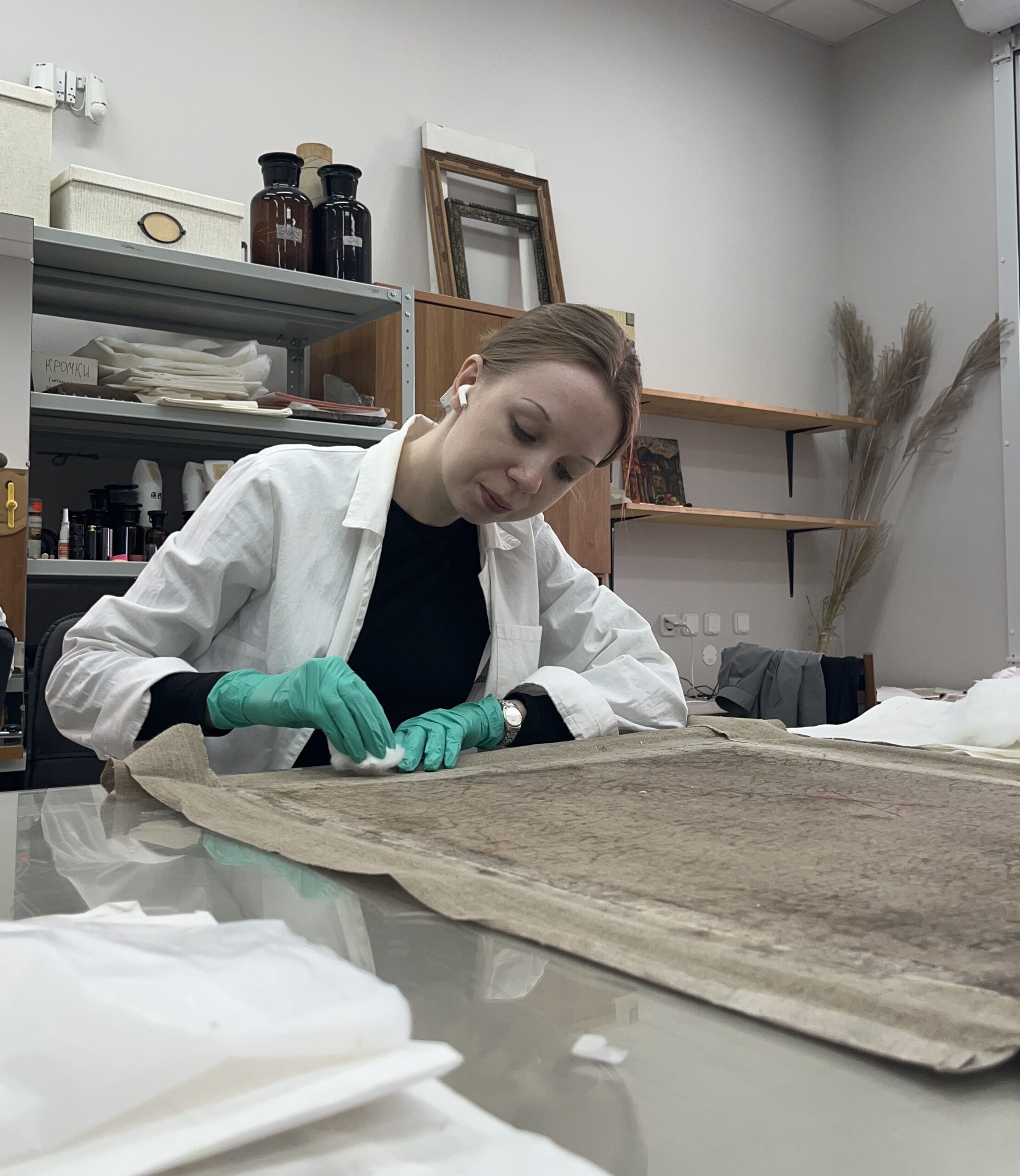
The transition from academic training to real-world practice was seamless for Yana, as her instructor, Ella Arkadievna, demonstrated real-world techniques during their classes. The restorer’s toolkit is more akin to a doctor’s instruments than an artist’s brushes. “We use scalpels, dental tools, and microscopes,” Yana explains. “For example, when examining a damaged piece, the microscope reveals the intricate layers of the canvas, primer, and paint. It’s a meticulous but fascinating process.”
Restoration often involves solving puzzles, such as finding suitable materials to replace missing fragments. Yana describes it as a game of Tetris, where each piece must fit perfectly. Young specialists may have doubts during the process, but the restoration council provides a platform for discussion and guidance. “When a specialist takes on a piece, they must present their approach to the council for approval and further discussion,” Yana says. “These consultations occur multiple times throughout the restoration process.”
Significant Restorations and the Value of Art
Among the many pieces Yana has restored, one holds particular significance: a portrait of a Dominican from the late 18th to early 19th century, which she restored for her diploma. “This is the oldest piece I have worked on,” she says. “I am immensely grateful to the National State Museum for entrusting me with this task.”
Restoring icons presents unique challenges. During her studies, Yana and her group worked on icons belonging to a church. “Restoring elements on wood is far more complex than working with canvas,” she explains. “It’s a multifaceted process that took us a year to complete. I believe that restoring icons requires a special state of mind.”
Yana also worked on a contemporary piece by a local artist. The large canvas, measuring 150×150 cm, was torn in several places and featured a mix of acrylic, collage, and graffiti techniques. “Restorers do not differentiate between pieces based on their importance,” Yana says. “We approach each piece with the same care and attention. For me, an 18th-century painting and a contemporary work are equally valuable.”
Advice for Cultural Enrichment
Yana offers valuable advice for those seeking cultural enrichment. “Visiting a museum as a leisure activity is always relevant, as there is always something new to discover,” she says. “The more frequently you visit, the more you notice. I recommend focusing on a specific section rather than trying to see the entire museum in one visit. Examine the details and consider what unites the works of a particular time and direction.”
Yana shares a useful tip for engaging with art: “Ask someone which painting they would hang in their home. This question encourages a critical eye and interest.” She hopes that people will approach cultural sites and the study of art with greater awareness. “Art gives us the desire to live fully,” she says. “Through any form or direction in art, we can view the world from different angles. Isn’t that a miracle?”
The National State Museum of the Republic of Belarus offers tours of the restoration department, providing a unique opportunity to learn more about this fascinating field.