Our Ancestors Were Always Fashionistas: An Interview with the Curator of the ‘Anthology of Beauty’ Exhibition
Our Ancestors Were Always Fashionistas: An Interview with the Curator of the ‘Anthology of Beauty’ Exhibition
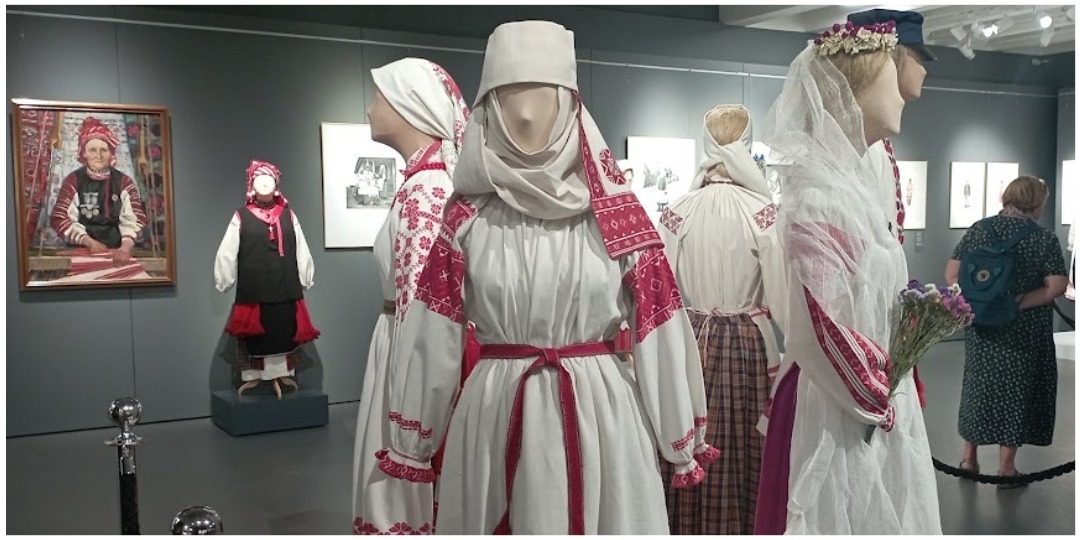
Until December 11, the National Art Museum is hosting the largest exhibition of traditional Belarusian costumes, titled ‘Anthology of Beauty.’ The exhibition features 600 textile items created by Belarusian folk artisans over various centuries and decades. These are not isolated costume items but complete historical ensembles characteristic of different regions and localities in Belarus. What details or techniques can modern fashionistas draw inspiration from in traditional Belarusian costumes? We asked Victoria Prokoshina, the exhibition curator and a research associate at the National Art Museum, to share her insights.
“Here we are dealing with ‘haute couture’ – high fashion”
“Our ancestors were always true fashionistas! If we draw parallels with the fashion world, we are dealing with haute couture here. These costumes were made for festivals and public appearances, created with the highest level of craftsmanship that still amazes us today. Despite our advanced technical capabilities, materials, and working conditions, their skill remains unmatched.”
Visitors at the exhibition often exclaim, “How did they do this? It’s impossible to replicate!” And indeed, it was never replicated. Each item of Belarusian costume is unique – an absolute exclusive. There are no two identical shirts, skirts, aprons, or belts, even if made by the same artisan.
Every woman told her story through her costume – it was very personal and sacred. It was a way to declare to the world who she was, what she loved, admired, and could achieve.
Six Fashion Houses of Belarus
“Such folk costumes are called ‘traditional’ because they adhere to historically established techniques and styles within which one could create and express themselves.”
There are six ethnographic regions: Western and Eastern Polesie, Podvinye, Podneprovye, Ponemanye, and Central Belarus. If we continue the analogy with the fashion world, these are our largest ‘fashion houses,’ each with its unique characteristics.
For example, the weaving of cloth differed by region. Western regions produced fine, thin linen, while Podneprovye and Podvinye favored coarser, less bleached linen. Western Polesie was known for its wide aprons made from two sewn ‘panels’ of 30-40 cm each, wrapping around the figure. In contrast, Podneprovye aprons were narrow. From region to region, the silhouette, cut, technique, and embroidery motifs varied.
There are about 50 ways to tie a ‘namitka,’ the traditional female headwear of Belarusian women. In the hands of an artisan, the headwear became an object of beauty and a marker of belonging to a specific community. A woman from Turov could always be distinguished from one from Grodno or Vitebsk. Maria Nikolaevna Vinnikova from the Academy of Sciences, co-curator of our exhibition, has studied the tradition of the Belarusian namitka for many years.
Traditional Belarusian Style and Peacock Feathers
The traditional ensemble of a woman’s costume always included a shirt, skirt, apron, and headwear – an unshakable tradition. Everything else varied by region. Local styles emerged, with unique interpretations of beauty and fashion in specific areas, such as Neglyubsky, Domachevsky, Maloritsky, and Turov-Mozyrsky styles. These styles are unmistakable due to their unique details, conceived by local artisans according to their ideas of beauty, harmony, sacrality, and practicality.
In traditional costumes, all functions were interconnected. Nothing was merely beautiful or practical without harmonizing with the rest of the costume. The protective, sacred function of clothing was very strong. No woman would ever show her navel in public – it was not just shameful but also dangerous. Clothing had to cover and protect the most vulnerable and precious parts of the body, such as a woman’s womb. It is no coincidence that the belt was always tied around the navel. For a married woman to leave the house with her hair uncovered was to invite trouble upon her entire family.
By the silhouette, color scheme, way of tying the belt, and wearing the headwear, one could accurately determine a woman’s region and even her village.
Traditional Belarusian Style and Evolution of Fashion
I know that it was not customary to wear skirts above the knee or shirts with short sleeves. Were there any fashionable ‘liberties’ allowed in the costume?
For example, the length of the skirt changed over time, which can also be called a fashion trend. Changes in the costume can be clearly seen in the example of two styles from Bezdezha. Look at how the skirt length changes, the width of the fold, the appearance of satin stitch embroidery, and how the knitted lace at the bottom of the apron is replaced by an ornamental ribbon. The namitka is replaced by a scarf. At the same time, we still recognize the Bezdezha style by its characteristic features. I wanted to show how the Belarusian costume evolved, changed over time, and was always a living phenomenon, not something stagnant and static.
In the center is an earlier Bezdezha style, on the right is a later one. On the left is the Kobrin style.
And what about this peacock feather in the female headwear of the Kobrin style – is this fashion or tradition?
This is a fashion trend. Many Belarusian magnates kept peacocks in their palaces and estates. Peasants saw these beautiful birds and could pick up a feather to decorate their costumes. But nothing was done thoughtlessly – we could learn from this! I am sure that the peacock feather here is not just for beauty. Our ancestors certainly knew that the peacock is an ancient symbol of wealth and eternal life, and the ‘eye’ on its feather carries a protective function.
Or these rooster feathers in the headwear of a matchmaker from Lelets – why specifically rooster feathers? Why was a rooster embroidered on aprons and wedding towels? In traditional culture, the rooster is a symbol of male strength and fertility. Like the horn – a symbol of abundance and fertility. Therefore, a woman’s hairstyle often imitated a horn. In Neglyubka, hair was traditionally gathered into a horn-like bun, and a scarf was tied on top: beautiful and sacred.
Barbie and the Scythian Headdress: A Synthesis of Fashion, Time, and Tradition
Are there examples of our ancestors borrowing costume details from other peoples?
There are, but such borrowings were not superficial – our artisans managed to rework the new element so that it became their own. Here are the headdresses from an expedition to the village of Khilchitsy in the Zhitkovichsky district of the Gomel region by Maria Nikolaevna Vinnikova. Their base repeats the female headdress of the Scythians! And the name is the same: our ‘galava’ is the same as the Scythian ‘kalaf.’