The Mysterious Soviet Aviation Disaster of 1950: A Tragedy Foretold
The VVS Moscow District Hockey Team
To comprehend the immense tragedy that befell the entire VVS Moscow District hockey team, it’s essential to understand the origins of their glory. This story is inextricably linked to Vasily Stalin, the beloved son of the Soviet leader.
Before 1946, the VVS team had never dreamed of topping the tournament charts, consistently placing no higher than fourth. However, in July 1947, Vasily Stalin was appointed commander of the Moscow Military District’s Air Forces. He promptly dismissed the team’s coach, Anatoly Tarasov, and began methodically recruiting promising players to create an elite sports division. The goal was to unite the people through sporting victories, showcasing triumphs beyond the battlefield. Vasily Stalin spared no expense in this endeavor.
The Rise of the VVS Team
Under the new leadership, the club attracted talented sportsmen who excelled on the ice, regardless of their military training. Young players were given houses on Khoroshevskoe Highway, while families received apartments on Peschanaya Street. Salaries were significantly higher than those of ordinary players—1,500 rubles for the main team and up to 2,000 rubles for privileged athletes. These were enormous sums for the post-war era! The club even earned an unofficial nickname: Vasily Stalin’s Gang. In the 1947/48 season, the VVS Moscow District hockey team became silver champions.
The Fateful Flight
Just before January 1950, the team changed leaders—Vasily Stalin was angered by the team’s manager, Matvey Goldman, and appointed Boris Bocharnikov as the new coach. Bocharnikov was determined to lead the team to victory and decided they should play against their main rival, the Dzerzhinetz hockey club.
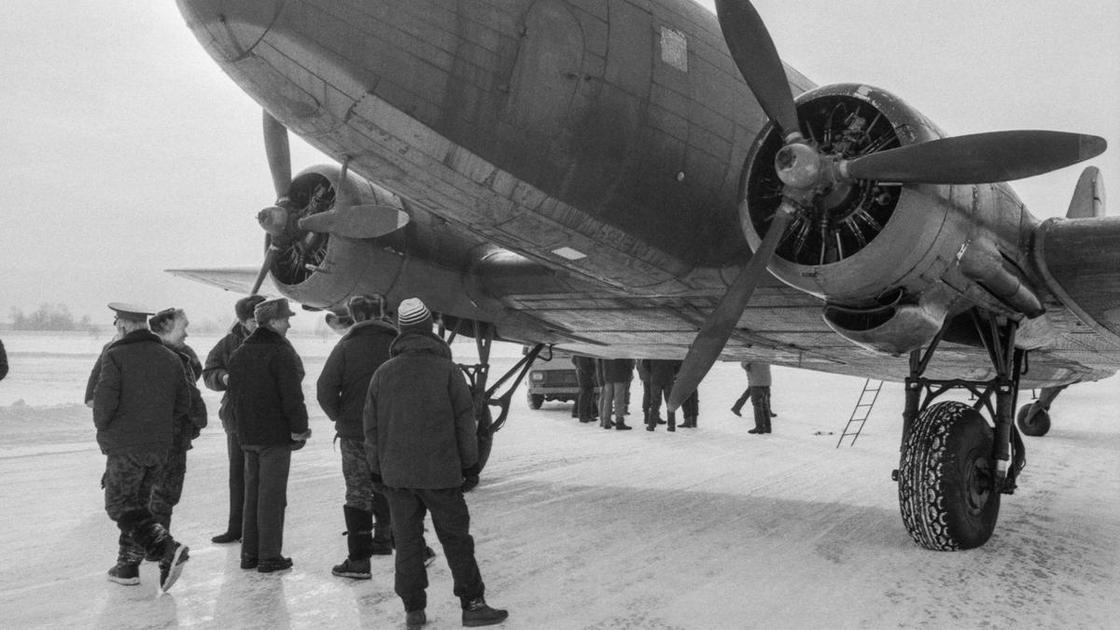
Initially, the team was supposed to travel to Chelyabinsk by train, but Bocharnikov insisted on using a military Li-2 aircraft to save time for additional training. Vasily Stalin agreed, despite it being illegal. On the morning of January 7, 1950, the plane carrying 11 players took off for the Urals but soon encountered a powerful blizzard. The aircraft made an emergency landing in Kazan.
The Crash
The aircraft’s captain, Ivan Zotov, insisted on waiting out the storm, but Bocharnikov contacted Vasily Stalin, who ordered an immediate takeoff. The plane attempted to land in Chelyabinsk but was diverted to Sverdlovsk due to poor weather conditions. Despite several attempts, the pilot could not land the Li-2 safely, and the aircraft crashed, killing everyone on board.
The Aftermath
The tragedy was immediately classified, and a new VVS team was quickly assembled to play against Dzerzhinetz in Chelyabinsk. The players were not given time to grieve and were taken to see the bodies of their fallen comrades before the game. The team won 8:3 but stood embracing for a long time in memory of their lost teammates.
The Cover-Up
There are several theories about why the tragedy was kept secret. One suggests it was to avoid overshadowing the recent celebration of Joseph Stalin’s 70th birthday. Another theory posits that Vasily Stalin himself classified the information, fearing his father’s wrath for using a military aircraft for the team’s travel.
The Prophecy of Wolf Messing
When the tragedy was first discussed 19 years later, a story emerged about Wolf Messing, a Soviet mystic, who allegedly predicted the aviation disaster and warned Vasily Stalin. However, this story is dubious, as the VVS team was Vasily Stalin’s pride and joy, and it’s unlikely he would risk his players’ lives based on a medium’s prediction.
The Truth Revealed
In the 1990s, documents about the Li-2 crash were declassified. It was revealed that due to the negligence of ground services, the radio stations at both the Koltsovo and Aramil airfields were operating on the same frequencies. This confusion led to the crash, as the navigator followed the wrong signals.
The Legacy
The VVS team, rebuilt after the tragedy, finished fourth in the 1949/1950 USSR Championship, narrowly missing third place. They went on to win three championships in a row and a national cup. In 1953, after Joseph Stalin’s death, the club was disbanded, and its players joined the CDSA.
For further reading, visit the Russian State Archive.