Believe in Yourself: Meet Liya, a Model and Teacher Overcoming Severe Cerebral Palsy
Believe in Yourself: Meet Liya, a Model and Teacher Overcoming Severe Cerebral Palsy
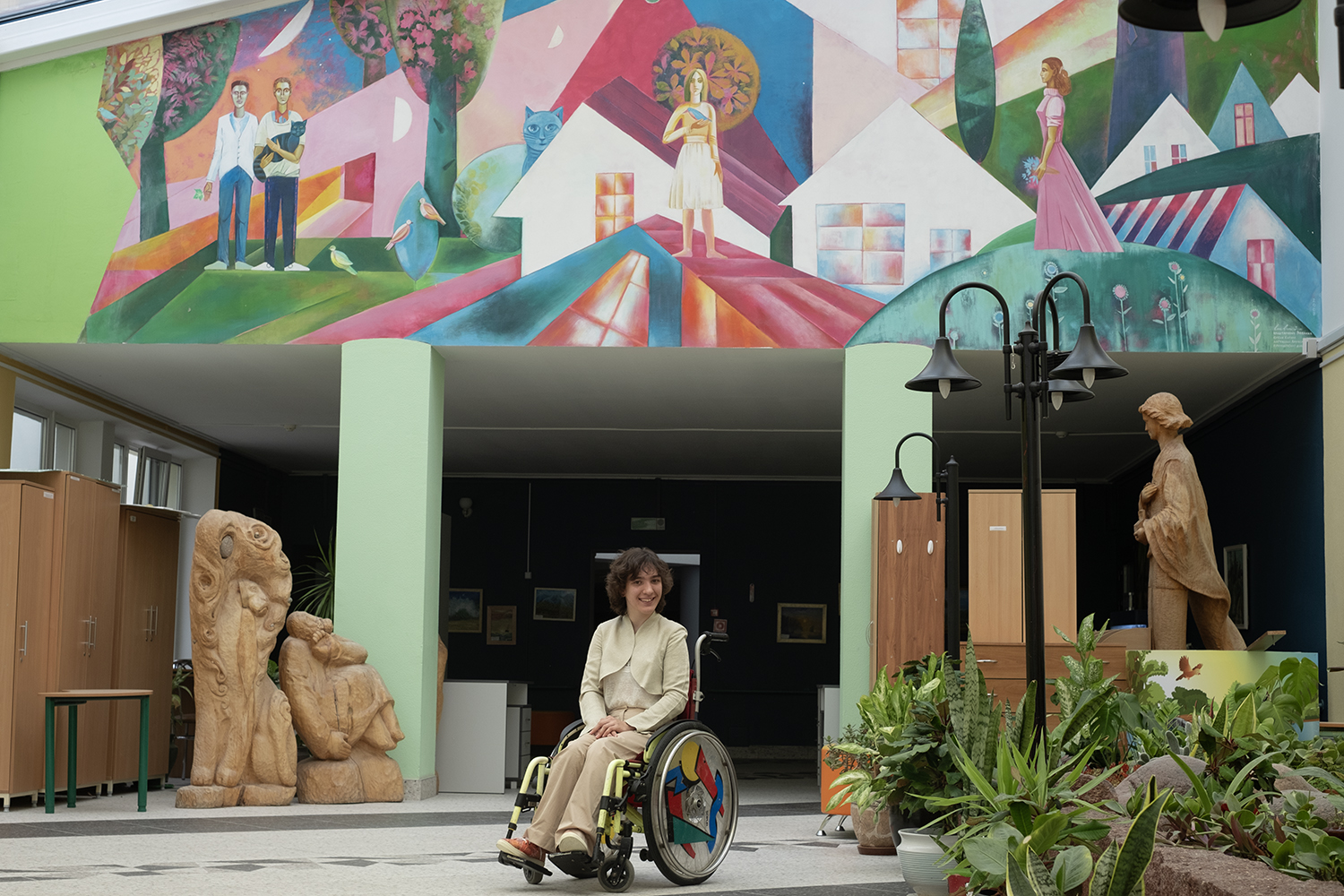
Liya has a severe form of cerebral palsy and uses a wheelchair. Despite this, she has been a model and a dancer. Doctors once suggested sending her to a school for children with intellectual disabilities, but she graduated from a regular school with honors. Liya didn’t speak until she was four years old. Now, she teaches English at the Republican Rehabilitation Center for Children with Disabilities. Together with A1 company, we share Liya’s story, each chapter of which says: the main thing is to believe.
Charity Festival
The A1 company, together with the Dinamo Stadium, invites you to the charity festival “In One Rhythm with A1,” which will take place on August 20 in Minsk. The event is completely free for participants with prior registration on the website pulse.a1.by. Everyone can participate in sports activities to dynamic music to help raise funds for the purchase of high-tech innovative diagnostic equipment for the Republican Rehabilitation Center for Children with Disabilities.
Inspiration from a Movie
Liya enthusiastically talks about the movie “Dolphin Tale.” She says it motivates her a lot. She doesn’t think that her life story is any less amazing than this film. Moreover, long before watching it, every day of the girl’s life was filled with boundless faith. However, it had not two, but three components: “I believe in myself,” “I believe in the world,” and “the world believes in me.”
Physical Achievements
Liya was born with cerebral palsy, spastic diplegia of the 3rd degree of severity (the most severe is the 4th). All the muscles of her body were tense and did not work well: the girl could not use her hands, sit, or speak.
Liya’s mother, Natalia, recalls: “At first, I was in a panic. But when Liya was one year old, I went to a consultation with a psychologist. I remember it like it was today: she writes, writes something at her desk, then lifts her head, looks at me, at Liya, sighs, and writes again. This went on for some time. And then she says: ‘Difficult case. Very difficult. But if you stop feeling sorry for yourself and start working, you will achieve a lot.’ I realized that the choice was: ‘Want to work, don’t want to work.’ And the results will be accordingly.”
Natalia chose to work. Continuous treatments, rehabilitation, and classes continued with redoubled effort. At the Republican Rehabilitation Center for Children with Disabilities, where we met, Liya underwent rehabilitation three times a year for many years. Massages, physical therapy, classes with a defectologist, speech therapist, and swimming pool sessions followed one after another.
It was not easy. During the massage, when the spastic muscles are kneaded and stretched, the child experiences pain and discomfort, and gets tired from numerous procedures. But the instructors and masseurs did not give Liya a chance to give up: “Children are children. She is tired, it’s hard, it hurts, she doesn’t want to. And the physical therapy instructor keeps saying: ‘You can do it, I believe in you, do this exercise two more times. Well done, and now one more time.’ And in the end, she did it,” Natalia recalls. At home, her mother also did not let her daughter give up. Physical education continued every day. And her mother also firmly said: “You can do it.”
Results came gradually: after each course of treatment and rehabilitation, there was a new micro-success. Now Liya sits not for two minutes, but for ten. And she can hold a spoon with her left hand, and now her right hand is “turned on.” Gradually, she began to try walking with special walkers, controlling her wheelchair herself, and taking care of herself in everyday life. At the age of four, after a course of facial massage, she began to speak — almost immediately in sentences.
The Republican Rehabilitation Center for Children with Disabilities was opened in 2000. Every year, more than 1,500 children with musculoskeletal disorders undergo rehabilitation at the center. The medical base of the center includes many (including original) rehabilitation methods: physical therapy, massage, medicinal electrophoresis, impulse electrotherapy, magnetotherapy, light therapy, acupuncture, classes on special simulators, swimming pool, medicinal baths, and much more.
Believing in Herself: How Liya Became a Model and Started Dancing
Liya does not dwell on memories of rehabilitation. It is unclear whether she does not want to remember or simply does not remember. All she says is: “It was hard and painful. But all the positive emotions outweighed everything.” While we talk, songs can be heard from the assembly hall, and dressed-up children scurry back and forth along the corridor. Today is the last day of the session, and the children are giving a concert. It is precisely such concerts, performances, and various clubs that come to mind when the girl talks about her childhood.
“I remember, at a New Year’s matinee, I played the role of a fox. They put ears on my head, and I had to recite a poem. I was performing for the first time, I was so excited! And at another holiday in the assembly hall, a clown came to us! He shook my hand! He just came up and shook my hand!” Liya laughs so sincerely and infectiously, with childish delight, as if she is not twenty-four, but four years old.